
 Call Us or Whatsapp 9779808220612
 Email Us [email protected]
- English [EN]
- Espanol [ESP]
- France [FR]
- Deutsch [DE]
- China [CN]
- Japan [JP]
- Arabic [AR]
- Hindi [HI]
Mera Peak Fitness Requirements: What Your Body Actually Needs Before You Climb
Published: June 2026 | Author: Nishan Dahal | Category: Trekking tips, Information
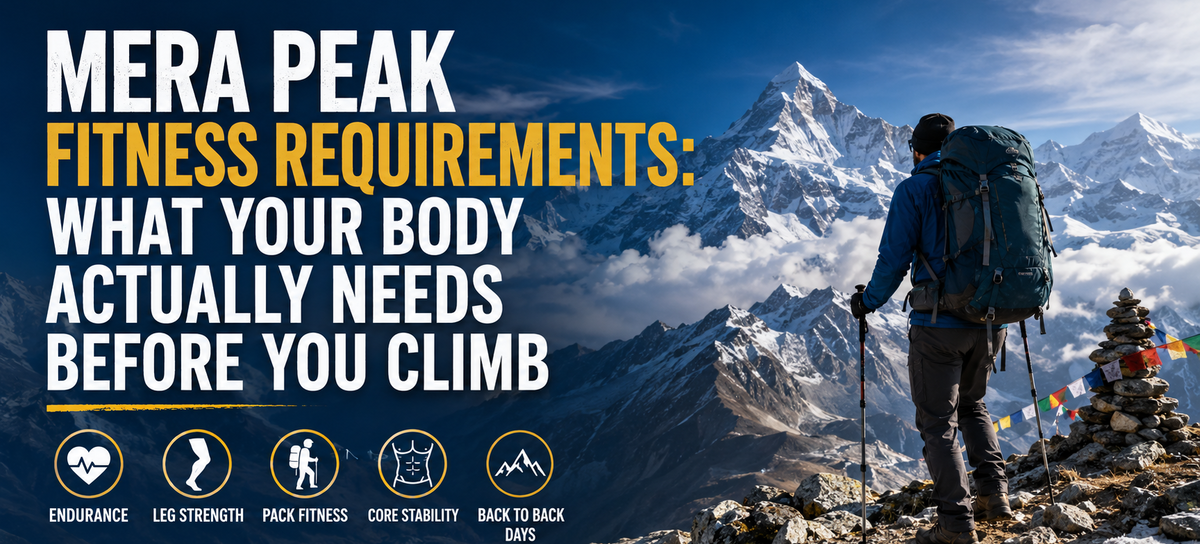
Mera Peak stands at 6,476 metres in the Khumbu region of Nepal, and if you ask most trekking agencies, they will tell you it is one of the more approachable high altitude climbs out there for people who are not professional mountaineers.
That is true to some extent because you do not need years of climbing experience or technical rope skills to attempt it. But approachable does not mean easy, and the mountain has a way of showing up every weakness in your preparation without any mercy.
People show up at base camp every single season having completely underestimated what this climb physically asks of them, and a big portion of those people never make it to the top. The ones who do summit and the ones who turn back early are rarely separated by luck or natural ability.
Almost every time, it comes down to how well they prepared their bodies in the months before they ever set foot in Nepal.
The Fitness Requirements Broken Down
Cardiovascular Endurance

If there is one physical quality that matters above everything else on this climb, it is cardiovascular endurance. Your heart and lungs will be working hard every single day for nearly two weeks straight, and the altitude makes that work feel significantly harder than it would at sea level.
What your body needs to be capable of:
- Walking uphill at a steady pace for two to three hours without needing to stop and sit down every twenty minutes
- Keeping your breathing under reasonable control on long climbs rather than gasping and struggling before the first hour is even done
- Recovering quickly enough during short breaks that you are ready to keep moving without needing a long rest every time you pause
- Maintaining output on days when your legs already feel the previous day in them, because on a long trek like this the tiredness builds and there are no real breaks until the itinerary specifically allows for one
How to build it:
- Running three to four times a week over the months before your trip is one of the most effective things you can do for your aerobic fitness
- Longer runs on weekends where you are out for ninety minutes to two hours at a pace where you can still hold a conversation build the kind of endurance that directly translates to long mountain days
- Cycling and swimming are equally good options if running puts too much stress on your knees or ankles, and both of them build the same aerobic foundation your body is going to need
- Do not train only at high intensity because the trek is a long sustained effort at moderate intensity and your training needs to reflect that honestly.
Leg Strength and Endurance

Your legs are going to carry you up and down this mountain for close to two weeks, and by the time the later days of the trek roll around they will already be holding a lot of accumulated fatigue.
If they are not strong enough before you start, the descents especially are going to become genuinely painful rather than just tiring.
What your body needs to be capable of:
- Coming down long steep sections without your knees aching badly or your thighs shaking and threatening to buckle under you.
- Climbing uphill with a loaded pack for extended periods without your legs burning out before the first hour is finished.
- Navigating constantly shifting and uneven ground without rolling your ankles or losing your balance repeatedly
- Keeping going on legs that already feel heavy and tired because by day eight or nine of the trek that is simply the reality and you need the reserves to push through it.
How to build it:
- Squats done regularly over weeks and months build the quad and glute strength that everything else your legs do on this mountain depends on
- Lunges and split squats develop the kind of single leg strength and stability that matters every time you step onto an awkward or uneven surface
- Step-ups onto a bench or a sturdy box replicate the movement of climbing steep trail more closely than almost any other exercise you can do indoors
- Pay real attention to the downhill sections during your training hikes because descending actually puts more strain on your muscles than going up does and it needs its own specific training if you want your knees to hold up.
Pack Carrying Fitness

There is a real and noticeable difference between being fit in a general sense and being fit to carry a loaded pack across mountain terrain for many hours at a time.
The weight on your back changes how your body moves, shifts load onto your joints, and creates a kind of fatigue in your shoulders, hips, and lower back that has nothing to do with how strong your legs are or how good your cardiovascular fitness is. You need to train specifically for this and not assume that other forms of fitness will cover it.
What your body needs to be capable of:
- Carrying ten to fifteen kilograms comfortably for five to six hours on hilly ground without your shoulders, hips, or lower back turning into a constant source of pain
- Keeping a reasonable walking pace under load on both uphill and downhill terrain
- Arriving at the end of a long loaded day feeling properly tired but not so wrecked that you cannot eat, set up your sleeping area, and function like a human being
How to build it:
- Start hiking with a pack several months before the trip and build the weight inside it gradually so your body has time to adapt without something getting injured
- Four to six hour weekend hikes on hilly ground with twelve to fifteen kilograms in your pack are the single best simulation of the actual trek that you can do before leaving home
- If you live somewhere flat with no hills to speak of, climbing stairs with a loaded pack is one of the most honest and effective substitutes available and it targets exactly the muscles that steep mountain trails will demand the most from
- Always train in the actual boots you plan to wear on the trek because arriving in Nepal with brand new unbroken boots is one of the fastest ways to turn the first week of walking into a miserable blistered experience
Core Stability

Core strength tends to get pushed to the back of trekking preparation because most people focus almost entirely on their legs and their cardiovascular fitness, but a weak core shows up in ways that make long mountain days noticeably harder and more uncomfortable than they need to be.
What your body needs to be capable of:
- Holding decent posture through seven or eight hours of walking even when the tiredness starts to really set in during the final stretch of the day
- Staying balanced and stable on rocky, uneven, and icy ground where you cannot always predict where your foot is going to land
- Supporting your spine under the weight of a pack day after day without your lower back becoming a persistent problem that slows you down or forces you to stop
How to build it:
- Planks held for sixty seconds or longer build the deep core stability that shows up during long days on difficult terrain
- Side planks work the lateral stability that keeps you upright and balanced when the ground beneath your feet is not giving you much to work with
- Dead bugs and bird dogs train the deep stabilising muscles of the core without putting unnecessary pressure on your lower back
- Single leg balance work builds the stability around your hips and ankles that matters every single time you step onto ground that is not flat or predictable
Back to Back Day Fitness
This particular quality does not get nearly enough attention in most articles about trekking preparation, but it might be one of the most practically important things you can build before Mera Peak.
The trek does not allow for full recovery between days. You finish a hard day of walking, sleep in reduced oxygen at altitude where your body does not restore itself as effectively as it does at home, and then you get up and do it all again.
Your body needs to know what that cycle feels like before it encounters it for the first time on the mountain. What your body needs to be capable of:
- Performing well enough on the second day of back to back long efforts even when your legs are sore and your energy is not fully back
- Managing the mental and physical grind of consecutive hard days without losing your motivation or falling apart emotionally
- Eating and sleeping well enough during multi-day efforts to keep your energy from dropping to a level where continuing becomes genuinely difficult
How to build it:
- Plan your weekend training so that you do a long hike on Saturday and another long hike on Sunday rather than resting between them
- Build the length and difficulty of those back to back days progressively over the course of your training period
- Notice how your body responds on the second day and use that information to figure out which areas need more work in the weeks ahead
How Much Time Do You Actually Need
- Three months or more: This is the preparation window that gives you the best possible outcome. You have enough time to build real aerobic fitness, strengthen your legs and core, do multiple long loaded hikes, and still give your body a proper rest before departure.
- Eight to ten weeks: This works well if you are already reasonably active and not starting completely from scratch. Consistent focused training over eight to ten weeks is enough to get most people to a solid level of readiness.
- Four to six weeks: This is a tight window and it really only works if you already have a decent base of fitness to build from. You cannot create a lot of new fitness in this time but you can sharpen and tune what you already have.
- Less than four weeks: Be genuinely honest with yourself about what is realistic. You can still have a meaningful and memorable experience on the trek, but reaching the summit may be very difficult if your preparation has been minimal.
What No Amount of Fitness Can Fully Prepare You For
Altitude affects people differently regardless of how fit or experienced they are. Some highly trained athletes have been stopped cold by altitude sickness while people with very modest fitness have reached the summit without serious trouble.
Being fit improves how well your body handles reduced oxygen but it does not make you immune to altitude sickness.
The best things you can do alongside your physical training are choosing an itinerary that includes proper acclimatisation days, drinking more water than you think you need every day on the trek, and being genuinely honest with yourself about what your body is telling you rather than ignoring warning signs because you badly want to reach the top.
Mera Peak rewards people who respect what it asks of them and prepare for it properly. Get the fitness right, give yourself enough time to build it, and standing on that summit is absolutely within your reach.