


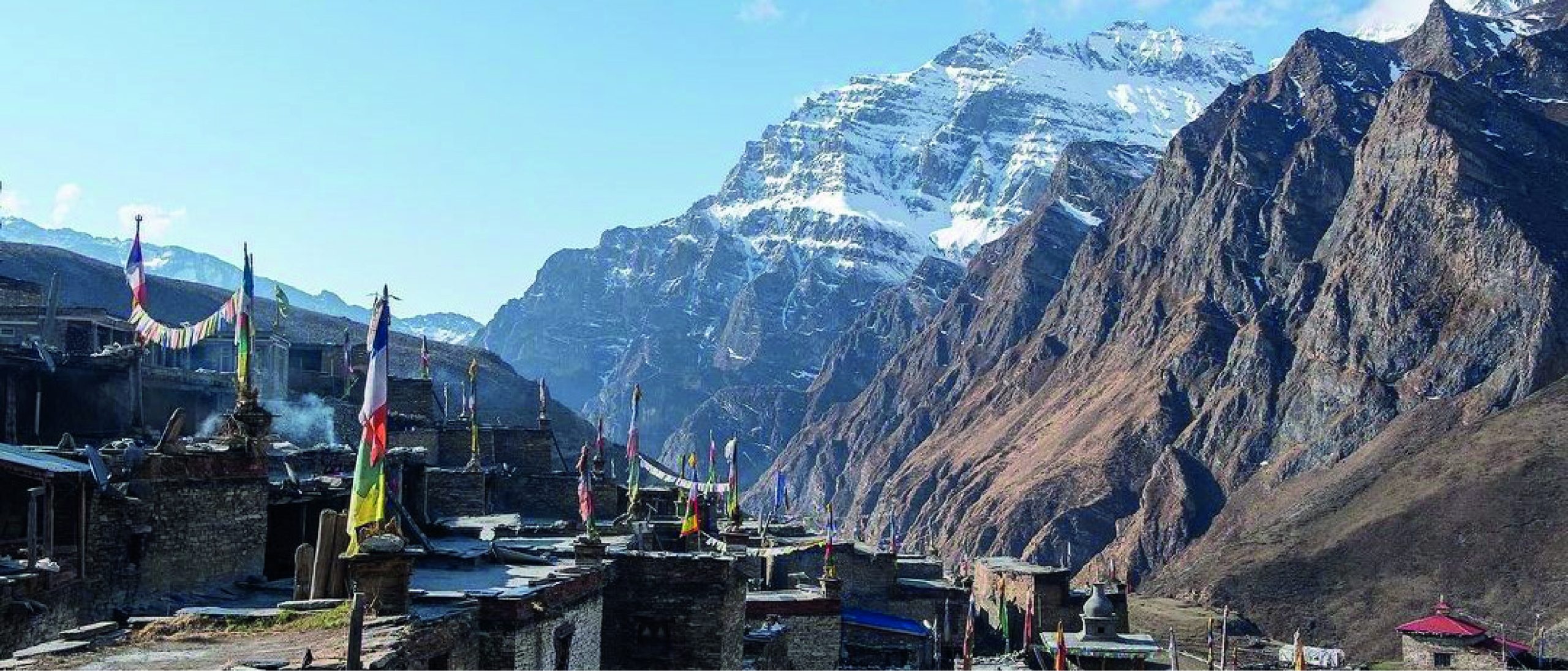
8-day Nar–Phu + Kang La Pass
 Duration: 8 Days
 Difficulty: Strenuous
 Accomodation: Hotel/ Lodge/ Tea House
 Meal: B-L-D
 Max. Altitude: 5,320m (17,454ft)
 Best Seasons: Spring (March-April-May) & Autumn (Sep-Oct-Nov)
8-day Nar–Phu + Kang La Pass
One of the less visited and regulated areas of the Annapurna is the Nar Phu Valley Trek. This trail is special and offers hikers amazing mountain views of the Annapurna and Manaslu Range. The Nar Phu valley walk provides rich local cultural experiences and varied scenery with snow-capped peaks. Hikers also. The Nar Phu valley walk offers a wealth of local cultural experiences, a bleak and varied scenery with snow-capped peaks. The opportunity to cross one of the most difficult mountain crossings, Kang La Pass (5310 meters), which is a prerequisite for the Annapurna circuit journey.
The Manaslu and Annapurna mountain ranges, two of the most amazing mountain ranges in the Himalayas, are directly in the center of the Nar Phu Valley. Mt. Manaslu (8,163 m) (26,781 ft), Annapurna II (7,940 m) (26,049 ft), Annapurna III (7,555 m) (24,786 ft), Annapurna IV (7,525 m) (24,688 ft), Gangapurna (7,455 m) (24,459 ft), Tilicho (7,134 m) (23,405 ft), Khangsar Kang (7 485 m (24.557 ft), Himlung (7,126 m) (23,379 ft), and 6,091 m (19,984 ft) are just a few of the great Himalayan peaks that can be seen during the trek. The most breathtaking range is the one that can be seen from Kang La Pass, which is 5310 meters high.
On the Nar Phu valley trip, hikers can take in a variety of scenery, from lush forests to arid, desolate areas. The lush pine, oak, and alpine forests are visible in the lower region. You can view the colorful geostructures and white snowcapped peaks of the Nar Phu Valley in the arid terrain above the Meta, where there aren’t many little trees.
Lifestyle of people in the area
The majority of the locals in the Nar Phu valley region are farmers, and they also make a living by raising animals. Their main source of income is livestock, since they care for the sheep and yaks to make money. In addition, hikers can see metalworking, carpet weaving, thanka paintings, and other crafts. The locals here are tribes of Mongolians, and they speak several dialects of their own language.
Views during the trip
After there, the Nar Phu Valley walking trail rejoins the Annapurna trip. And we depart from lovely towns and high-altitude Yak grazing fields. During our trek, we will also learn about Tibetan-influenced customs and culture while taking in breathtaking vistas of snow-capped mountains. After that, we traverse Thorong La Pass, which takes us to the pilgrimage sites of Muktinath and Jomsom. After that, we take a plane back to Pokhara and end our trekking journey with a picturesque drive to Kathmandu.
Highlights of the trip
- Discover the unspoiled Tibetan villages of Nar and Phu Camp, or stay in teahouses in the area surrounded by historic monasteries and yak herders.
- In a single, spectacular circuit, traverse both Kang La Pass and Thorong La Pass.
- See a variety of landscapes, including broad alpine plateaus, glacier valleys, and deep canyons and small gorges.
- Discover the spiritual power of Muktinath, a holy destination that is adored by both Buddhists and Hindus.
Detailed Itinerary - 8-day Nar–Phu + Kang La Pass (8 Days)
Today we travel from Kathmandu to Koto. The walk across the untamed Nar Phu Valley begins in Koto. It’s a difficult but beautiful drive from Kathmandu, which is around 140 miles (230 kilometers) away. What to anticipate on the trip from Kathmandu to Koto is as follows.</span>
After breakfast at around eight in the morning on this second day, we will begin our journey to Meta, our destination for the day. There is a flat section, an uphill section, and a road on one section of the route to Meta. The majority of the route is a bush road. We will arrive at our lunch location after around three hours of walking. There are two tea cafes there, however they just serve tea and coffee and lunch. We will travel for around four hours again after lunch to get to Meta.
We shall travel to the Phu Gaon on this day. Today’s road is rocky and dry. We will pass by numerous other villages in the area, including Chyaku and Kyang, en route to Phu Gaon. On this day, it will take approximately six to seven hours to get to Phu Gaon. There are rivers along the route, and it is somewhat rugged. The course has a steady rise today. The terrain is barren and dry. The Annapurna range and Himlung Himal are clearly seen from the location.
We have to climb up to Nar Phedi today. The trip from Phu Gaon to Nar Phedi will take about five hours. As we approach the low height, the road gradually descends. We start by taking the same path back to Meta. We next proceed to the Nar Phedi monastery via an alternate path. In fact, we are spending the night in this monastery.
There is not much walking required on the sixth day of the expedition. It is a three-hour hike. The area doesn’t have any such notable landmarks. The trail is rocky and quite dry. Since the hike isn’t long, we’ll eat lunch once we get to Nar Village. Located in a remote and limited area of Nepal, Nar village is a large community. There are about a hundred local residences. The Sherpa and Tibetan people make up the majority of the local population. The residences have a wide variety of designs. One house appears to have been built on top of the other, and so forth.
Among the several days of the Nar Phu Valley Trek, this one is going to be incredibly lengthy and challenging. On this day, we must travel to Kang La Pass, a high pass. From Nar village, it takes about five to six hours to go to Kang La Pass. Since we will be ascending to a high altitude, the path up to the Kang La Pass is difficult.
The elevation of Kang La Pass is 5320 meters. From the high pass, we can view Himlung Himal, the entire Annapurna range, and even Humde Airport in Manang. On this particular day, we will pack a lunch and eat it in Kang La Pass. We will travel to Ngawal after taking a short break. Because of the intense snowfall and steep slope on the way to Nawal, crossing the Kang La Pass during the winter is extremely difficult.
We will drive a Jeep from Ngawal to Beshisahar because it has a direct road link. There is a jeep nearby since the bus is unable to get to Ngawal. Bicycles are able to access the region. On the way, we’ll eat lunch. The trip to Beshisahar will take roughly six to seven hours. The majority of the road is off-road. Pitch is only present within 10 miles of the location.
Depending on traffic and road conditions, the about 176-kilometer (109.3-mile) drive from Besisahar to Kathmandu usually takes 6 to 8 hours. With breathtaking views of verdant hills, valleys, and rivers, notably the Marshyangdi River, the route mostly follows the immaculate Prithvi Highway. We can even visit Pokhara for more visits.
What's Included
Below is a detailed list of everything provided in the Nar–Phu Valley & Kang La Pass Trek package:
- Airport Assistance & Transfers
Comfortable private vehicle for all airport pick-up and drop-off services upon arrival and departure. - Hotel Accommodation in Kathmandu
2 nights in a well-rated 3-star hotel with daily breakfast (Twin/Double sharing basis). - Transportation Services
All necessary ground transport as outlined in the itinerary, including:- Kathmandu → Besisahar (private vehicle)
- Besisahar → Koto (local/private jeep depending on package)
- Return transportation from the trek endpoint back to Kathmandu
- Meals on the Trek
Nutritious meals — breakfast, lunch, and dinner — served at lodges throughout the trek. - Lodge/Tea House Stays
Accommodation in traditional tea houses in Nar and Phu villages and along the Annapurna trails. - Guiding & Support Staff;
A professional, government-certified Trekking Guide and reliable Porters
- Restricted Area Permits & Entry Fees
All mandatory permits including:- Nar–Phu Restricted Area Permit
- ACAP (Annapurna Conservation Area Permit)
- TIMS Card (if applicable)
- Group Gear & Safety Supplies
Essential group gear such as a medical kit, pulse oximeter, route map, and basic safety equipment. - Insurance for Field Staff
Guides and porters are fully insured for medical emergencies and accidents. - All administrative fees, government taxes, and company service costs.
What's Not Included
The following items are NOT part of the Nar–Phu Valley & Kang La Pass Trek cost:
- Personal Travel Insurance
- Personal Trekking Equipment
- Additional Personal Costs
Laundry, souvenirs, and miscellaneous spending. - Gratuities for Crew, Tips for guides and porters (customary but optional).
- Emergency Evacuation & Medical Bills
Any rescue operation or hospital expenses (covered by insurance if purchased).
Departure Dates
Route Map & Gallery
Frequently Asked Questions - 8-day Nar–Phu + Kang La Pass
This trek is considered challenging, suitable for trekkers with prior high-altitude experience due to steep climbs, remote terrain, and high-altitude passes.
The trek usually takes 8–14 days, depending on your itinerary, acclimatization needs, and whether you combine it with the Annapurna Circuit.
Trekkers need:
Restricted Area Permit (RAP) for Nar–Phu
- Annapurna Conservation Area Permit (ACAP)
A TIMS card is not required for restricted areas.
The highest point is Kang La Pass at 5,322 meters (17,460 ft).
Yes. The trek reaches high altitudes quickly, so proper acclimatization, hydration, and pacing are essential.
The best seasons are:
Spring (March–May)
Autumn (September–November)
These months offer stable weather, clear views, and safer pass crossings.
This trek is not recommended for beginners. Prior high-altitude trekking experience is highly recommended.
Yes. A licensed guide is mandatory due to the restricted area permit and remote terrain conditions.
The cost typically ranges from USD 1,000–2,000, depending on group size, guide/porter services, permits, and trekking duration.
Yes. Nar and Phu villages remain some of the most isolated Himalayan settlements with preserved Tibetan-Buddhist culture and minimal modernization.
Essential items include warm clothing, waterproof layers, crampons/microspikes (depending on season), trekking poles, high-quality boots, a sleeping bag (-15°C), and a basic medical kit.
Kang La Pass is physically demanding due to steep ascents, high altitude, and possible snow. Proper fitness and acclimatization are crucial.
Useful Info
Difficulty of the Nar Phu valley trek
One of the biggest and most difficult obstacles on a trip in the Nar Phu Valley is the 5,320-meter-high Kang La Pass. You truly get a sense of the Himalayas’ untamed splendor during this portion of the journey.
Guides frequently begin the icy journey before daylight because it typically takes hours to reach the summit. One of the best views is available from the highest point, where you can get a close-up look of Tilicho Peak, Annapurna II, and Gangapurna.
Crossing the pass is a tremendous accomplishment that makes you feel pleased more than it does physically. You must be ready because this area frequently experiences severe wind and snow. After reaching the summit, the route descends to Ngawal, where the Annapurna Circuit resumes. This striking crossing is what sets Nar Phu Valley apart from other hiking areas in Nepal.
Nar Phu Valley Trek Cost
The cost of the Nar Phu Valley Trek is $1185 per person, which includes necessary services like guides, food, lodging, and permits. Everything on the trek list, which is already covered in our include/exclude part, will be covered. With the best services, we offers one of the best deals at this price. The pricing of the Nar Phu Valley Trek package may change occasionally as a result of unforeseen events like additional days or mishaps.
Nar Phu Valley Trek Permit
The government of Nepal has maintained the Nar and Phu Valley as a restricted area in order to protect the local customs and culture. In the Nar and Phu valleys, a specific Nar Phu Valley Trek Permit would be ideal. Permits for the Nar Phu Valley Restricted Area are issued by your trekking agency in Nepal.
Each person had to pay U$100 per week for the Nar Phu permission. You will have to pay $10 to $15 per day if you remain longer. A certified guide must go with you; independent hikers are not permitted to enter the Nar Phu Valley. Additionally, only two hikers can issue a Nar Phu Valley Trek Permit. Then there are permits for the Annapurna Conservation Area Project (ACAP).
Acclimatization on Nar Phu trek
The Nar Phu Valley Trek schedule includes a day of acclimatization during which we can explore a variety of sites. We can walk up to the Himlung Himal Base Camp if we follow our program, but we can also visit a lot more locations on the optional rest day. Another excellent choice for a day of relaxation is Tashi Lhakhang Gompa.
Under the direction of a nun, you will explore this stunning monastery. The monastery also features a library and prayer halls. The monastery is one of the 108 famous Buddhist monasteries in the world. From Braga, Tashi Gompa is a detour to Milarepa’s Cave.
Book 8-day Nar–Phu + Kang La Pass with Confidence
Join Top Trail Nepal, your trusted local trekking agency in Kathmandu, for the journey of a lifetime. Our experienced guides, strong safety record, and personal service make your Everest dream come true.

- $1285 1 people
- $1085 2 people
- $1015 4 to 6 people
- $985 7 to 12 people