


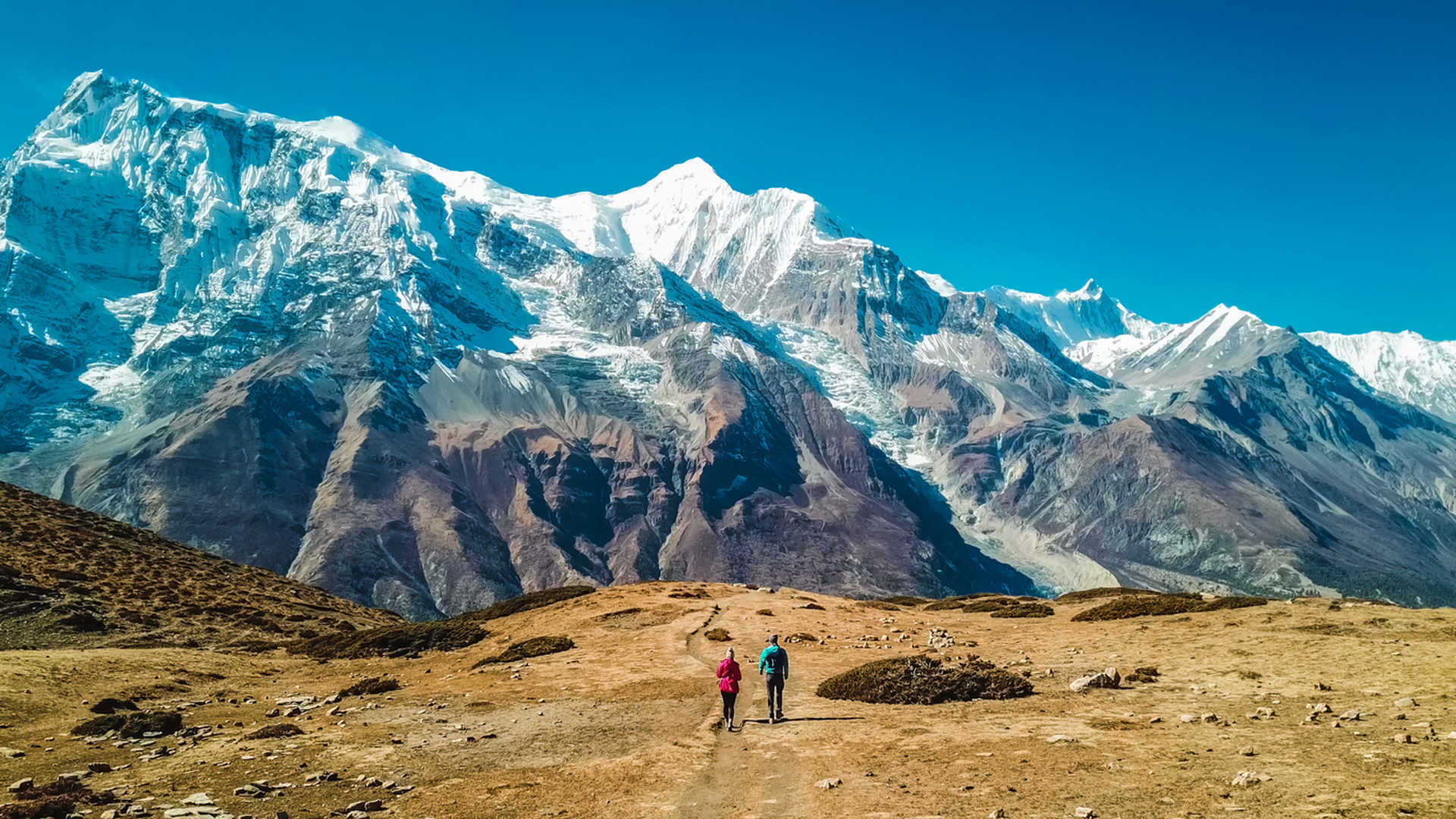
Annapurna Circuit Trek
 Duration: 9 Days
 Difficulty: Adventure
 Accomodation: Hotel/ Lodge/ Tea House
 Meal: B-L-D
 Max. Altitude: 5,416m / 17,769ft
 Best Seasons: Spring (March-April-May) & Autumn (Sep-Oct-Nov)
Annapurna Circuit Trek
Generally speaking, one of the greatest trekking paths in the world is the Annapurna Circuit trek. Yet our trekking field staff of guides who have been working for decades have provided their experience and recommendations to build this fantastic 9-day Annapurna circuit trek.
Trekking in Annapurnna Circuit
Simply put, Annapurna trek is a lifetime experience. The original 8-day Annapurna circuit trip, renowned for its mix of nature and culture, also presents some of the most stunning mountain scenery of the Annapurna, Dhaulagiri, and Manaslu ranges.
Among the many untamed, high-altitude treks that cut through the hills and ridges of this breathtaking Himalayan scenery are the Annapurna Base Camp Trek, the Mardi Himal Trek, and the Poon Hill Trek.
But the best trekking trail of the Annapurnas is the Annapurna Circuit Trek. It’s this classic trekking experience, usually two or three unforgettable weeks long, going around the Annapurna massif and exposing trekkers to a breathtaking range of scenery.
Incomparable experience in the journey
Annapurna Circuit Trek is an exciting overland trip from Nepal’s high-altitude passes to the subtropical lowlands of its forested foothills.
But it typically takes weeks to fully appreciate this amazing trek, one of which has been a deterrent to prospective travelers who do not have that amount of time available to see the Himalayas. Our eight-day short Annapurna Circuit Trek, though, is only eight days to do, with transport from Kathmandu.
With years of experience between them, our expert guides have carefully crafted this fast-paced trekking itinerary. We’ve incorporated top-performing acclimatization days into this itinerary so that we keep the risk of altitude sickness at a minimum while we climb ever higher into some of Nepal’s most spectacular alpine vistas.
Fit hikers and trekkers will find this trek as a good challenge, though it is a strenuous trekking trail that takes five or six hours of daily walking.
Sights to view on the trek
It is not possible to adequately put into words the stunning vistas of the Annapurnas; reading about this trek is one thing, but being in the shadow of some of the Earth’s highest mountains is quite another.
You will start to realize why trekking in Nepal is so alluring when the Himalayan winds whip through your hair and an endless trail beckons you further into the Annapurna Conservation Area remoteness.
It’s not only scenery, however; this region of Nepal has ancient monasteries, Himalayan villages in the traditional style, and notoriously friendly inhabitants, too. You’ll ride through alpine towns as you make your way through high country in the area and get an up-close look at the long-standing traditions and culture that are so inextricably linked to these mountains.
Highlights
- Experience Kathmandu’s historic temples and UNESCO World Heritage sites.
- A soak in hot spring natural water
- With outstanding views of Mt. Annapurna, Chulu West, Dhaulagiri, Thorung Peak, Nilgiri, Tukuche Peak, Lamjung Himal, Annapurna II, and Annapurna IV, Manang village is a picturesque typical Himalayan village.
- A day in Pokhara with lovely surroundings
- Beautiful waterfalls, deep gorges, glaciers, and lakes
Detailed Itinerary - Annapurna Circuit Trek (9 Days)
You start off with a ten to eleven hour long, picturesque drive from Kathmandu to Chame, the headquarters of Manang District. Scenic hills, rivers, and terraced farmlands are driven past for ten to eleven hours. After reaching Besisahar on the Prithvi Highway, the drive proceeds to Chame on rugged mountain roads. You have the luxury of relaxing and admiring the view of Lamjung Himal as well as nearby peaks after you arrive at Chame.
Driving time: 10–11 hrs
Night stay: Tea house in Chame
The trek begins with hedging to a fine and gentle walk in the pine forests crossing suspension bridge over Marsyangdi River a few times. Scenic views of Annapurna II and Pisang Peak make up the trail. The valley opens as you approach Pisang and the natural environment changes with alpine desert scenery and dry weather.
Trekking time: 5–6 hrs
Overnight halt: Tea house in Pisang
The alternative routes from Pisang are the upper scenic route via Ghyaru and Ngawal with superb views of the Annapurna range, and the lower route down via Hongde. Tibetan-style villages with monasteries and prayer wheels line the route. On reaching Manang, you’ll encounter a lively village complete with shops, bakeries, and trekking lodges.
Trek duration: 6–7 hrs (upper trail is recommended)
Night stop: Manang tea house
This day is reserved for acclimatization to the altitude. Short hikes can be taken to the Ice Lake (Kicho Tal), Gangapurna Lake, or viewpoints with close-up photographs of Tilicho Peak, Annapurna III, and Gangapurna. Since you get to experience its distinct culture and way of life, a hike to the Manang village is also rewarding.
Activities: Trek to viewpoints / side trips
Overnight at Tea house in Manang
The trail from out of Manang rises further and further into juniper forests and alpine pastures. Before you reach Yak Kharka, a meadow where local herders graze their animals, you pass through tiny villages like Gunsang.
The trek is rewarded with stunning views of the mountains and a feeling of moving ever deeper into the high Himalayas.
Trek time: 4–5 hrs
Overnight stay: Thorong Phedi tea house
Although today’s hike is short, acclimatization is required. With views of Gundang, Syagang, and Thorung Peak, the trail continues upwards to the valley. You will ascend gradually to Thorong Phedi, the base camp of Thorong La Pass, beyond a wooden bridge. Phedi is more safe to stay for gradual acclimatization, but some trekkers may prefer to trek an additional hour to High Camp (4,880m) for an easier day tomorrow.
Trek duration: 4–5 hrs
Overnight at: Tea house in Thorong Phedi
Today is the hardest and best day of the trek. Very early in the pre-dawn hours you will commence with your long, steep ascent to Thorong La Pass, the highest point on the Annapurna Circuit. With a stunning 360-degree view of the Himalayas, prayer flags dot the pass. You will drop way down to arrive at Muktinath, an important pilgrimage temple for Buddhists and Hindus, after spending some time up in the mountains.
Trek duration: 8–9 hrs
Night halt: Muktinath tea house
After breakfast you will drive through the barren land of Mustang on a jeep ride Muktinath to Jomsom. You can get to Pokhara from Jomson either on the road, or by flying. When you finally arrive in Pokhara, take it easy at Phewa Lake and cafes to toast your accomplishment.
Travel option 1: Drive Muktinath – Jomsom (2 hrs), and then fly Jomsom – Pokhara (20 min)
Travel option 2: Drive Muktinath – Pokhara (8–9 hrs by road)
Overnight stay: Hotel in Pokhara
Kathmandu is the site of your air travel to on that day. Fly for 25 minutes or catch a tourist bus that will take you through scenic hills, rivers and villages in six to seven hours. Farewell dinner in Kathmandu or spend time around Thamel up on arrival.
Option 1 for the travel: you can simply take a Fly from Pokhara to Kathmandu (25 min)
Option 2: Tourist bus Pokhara – Kathmandu (6-7 hours)
You’ll trek around the Annapurna Foothills on this 9-day adventure, going inside some of the highest passes in Nepal for spectacular views and traveling through atmospheric local villages.
What's Included
A complete breakdown of all services covered in the Annapurna Circuit Trek package:
- Arrival & Departure Transfers
Private airport pick-up and drop-off in a comfortable vehicle. - Kathmandu Hotel Accommodation
2 nights in a 3-star hotel with breakfast (Twin/Double sharing). - Transportation
All ground transportation as per itinerary:- Kathmandu → Besisahar (private or tourist vehicle)
- Besisahar → Chame/Jagatsukh (local jeep/private jeep depending on package)
- Jomsom → Pokhara flight or drive
- Pokhara → Kathmandu (tourist bus or flight)
- Meals During the Trek
Full-board meals during trekking: breakfast, lunch, and dinner at tea houses. - Tea House Accommodation
Standard lodge/tea house stays throughout the trek. - Professional Trekking Crew
Experienced, government-licensed Trekking Guide and Porters (1 porter for every 2 trekkers) including their:
- Salary
- Insurance
- Meals
- Accommodation
- Gear
- Trekking Permits
All required trekking permits:- ACAP (Annapurna Conservation Area Permit)
- TIMS Card
- Group Equipment
Basic group equipment including medical kit, safety equipment, oximeter, and trekking map. - Medical Kit
First-aid kit carried by your trekking guide. - Staff InsuranceFull insurance for all trekking staff (guide & porters).
- Company Service Charge & Government Taxes
All official service charges, VAT, and government taxes.
What's Not Included
- Travel Insurance
- Personal Trekking Gear
- Personal Expenses
Laundry, souvenirs, etc. - Tips for Guide & Porter
(Gratuity is customary and highly appreciated.) - Emergency Evacuation Costs
Helicopter rescue or emergency medical evacuation (covered by your insurance).
Departure Dates
Route Map & Gallery
Frequently Asked Questions - Annapurna Circuit Trek
The trek usually takes 7–14 days, depending on the starting/ending points and acclimatization days.
The best seasons are March–May (Spring) and September–November (Autumn) when the weather is clear, safe, and ideal for mountain views.
It is considered a moderate to challenging trek due to long walking days and high altitude, especially near Thorong La Pass.
Trekkers need:
TIMS Card
Annapurna Conservation Area Permit (ACAP)
The highest point is Thorong La Pass at 5,416 meters (17,769 ft).
Yes, altitude sickness is a concern due to the high elevation. Proper acclimatization, slow pacing, and hydration are essential.
Beginners with good fitness can do it, but it is more demanding than other Nepal treks. Training beforehand is recommended.
Typical cost ranges from USD 900–1500, depending on itinerary, guide/porter services, food, accommodation, and transport.
The complete circuit covers 160–230 km, depending on route variations and road access points.
Yes. Despite some road sections, trekkers can still follow alternative trails that preserve the authentic trekking experience and natural beauty.
Yes. Insurance that covers high-altitude trekking up to 6,000 m is strongly recommended.
Essentials include warm layers, sturdy trekking boots, down jacket, rain gear, sleeping bag, trekking poles, water purification tablets, and basic first aid.
Useful Info
Best Time for the Trek
You can trek the Annapurna Circuit any time of the year, but the most favorable times to do it are during spring (March to May) and autumn (September to November). The finest mountain vistas are available during these times, when the weather is mostly good and temperatures are moderate. Autumn brings clear skies after the monsoon, and spring brings wonderful scenery and rhododendron flowers. If you dislike so many crowds, winter is also feasible, although it gets bitterly cold and snow can block high passes like Thorong La. Although the lower valleys appear to be lush green, monsoon time is the worst because of rain, slippery trails, and leeches.
Accommodation
The majority of the accommodation on the Annapurna Circuit is offered by local families in tea houses or lodges. The tea houses are better and can provide en-suite bathroom single rooms in lower-lying villages, like Chame and Manang. The accommodations are more basic higher up, generally with shared bathroom and rooms. Tea house restaurants are generally where meals are eaten, and menus provide a combination of Tibetan, Nepali, and simple Western-style cuisine. Trekkers can unwind and rest in these simple yet comfortable tea houses after exhausting day hikes.
Difficulty of the Trek
The Annapurna Circuit is a difficult trek owing to its length and Thorong La Pass height of 5,416 meters. Though technical climbing skill is not necessary for the trek, climbers can expect five to seven hours of walking daily on varied terrain. Because of the altitude, acclimatization is necessary, and to prevent altitude sickness, rest days are included in most itineraries at locations like Manang. While psychological attitude, physical fitness, and endurance are necessary, first-time trekkers can do the trek with proper pace and regard for caution.
Cultural Experience
One of the main attractions of the Annapurna Circuit is its wide range of cultural diversity. Gurung, Thakali, and Manangi people, each with their own customs, dialects, and traditions, populate the trek’s villages. There is a Tibetan Buddhist presence in Manang and surrounding villages, where monasteries, prayer flags, and chortens line the trail. The Muktinath Temple, a very holy place for Buddhists and Hindus, is a powerful cultural and religious attraction. The opportunity to witness village farming and daily life and the hospitality of tea houses are some of the trek’s cultural attractions.
Safety and Security
The second most important selling point of the Annapurna Circuit is its rich culture. The Gurung, Thakali, and Manangi tribes, who possess their own language, dialects, and traditions, occupy villages along the trek. There are profound Tibetan Buddhist influences in Manang and the surrounding villages, and the trek is interspersed with monasteries, prayer flags, and chortens. Muktinath Temple, sacred to Buddhists and Hindus alike, is a key cultural and religious highlight. The view of local farming and village daily life, together with the homey hospitality of tea houses, spices up the cultural variety of the trek.
Permits
There are two significant permits to be procured for the Annapurna Circuit trek. One is the Annapurna Conservation Area Permit (ACAP), which generates funds for biodiversity and nature conservation efforts within the area. The other one is the Trekkers’ Information Management System (TIMS) card, which keeps the trekkers’ information for security and tracing purposes in case of necessity. Both the permits can be arranged either via a licensed trekking agency or in Kathmandu or Pokhara. They need to be taken everywhere since they are being checked at various points along the route.
Reviews



My friends and I trekked the Annapurna Circuit with Tindu. We had a brilliant time – Tindu was knowledgable, a lovely guide and we felt incredibly safe in his hands (particularly around managing altitude and altitude sickness). I wouldn’t hesitate to recommend him and his company, and look forward to my next Nepalese trek in the future!
Book Annapurna Circuit Trek with Confidence
Join Top Trail Nepal, your trusted local trekking agency in Kathmandu, for the journey of a lifetime. Our experienced guides, strong safety record, and personal service make your Everest dream come true.

- $1150 1 people
- $1075 2 people
- $1050 4 to 6 people
- $985 7 to 12 people
- $950 13 to 19 people