


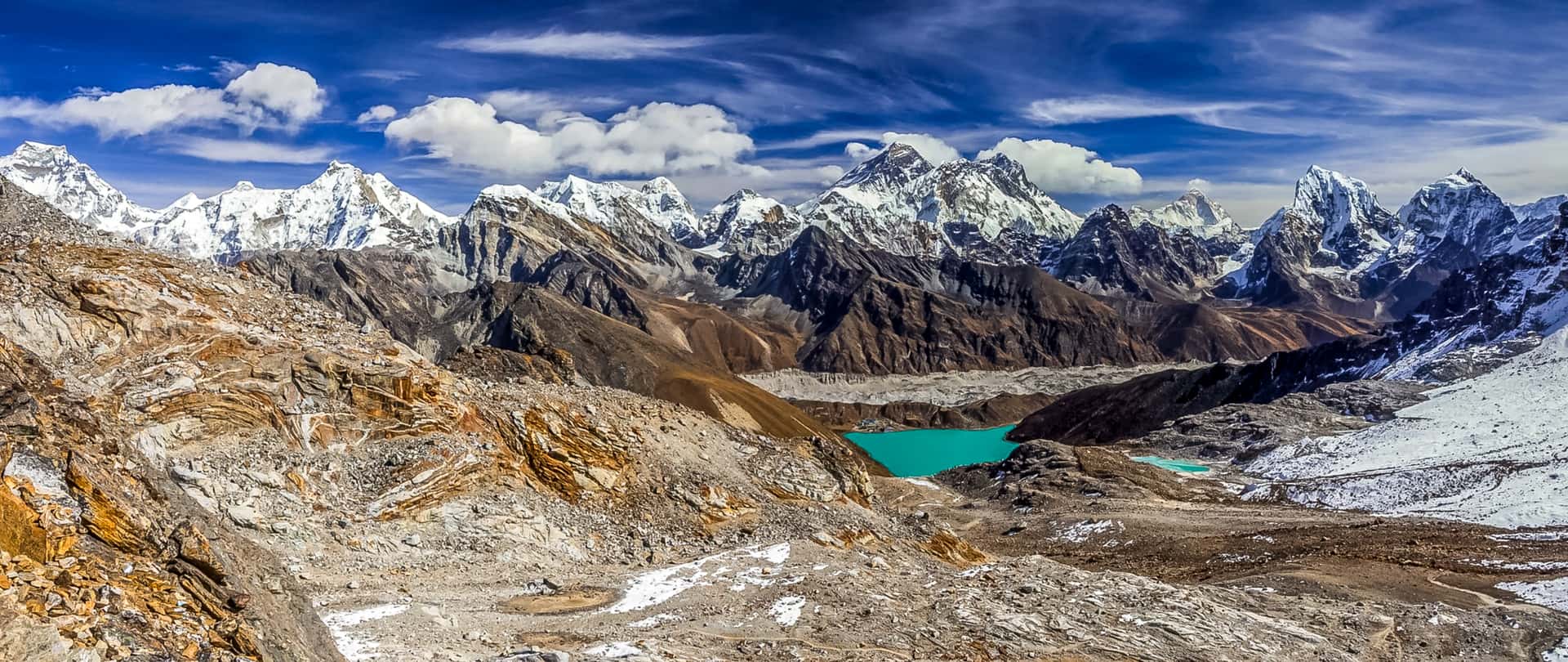
Everest 3 Pass Trek
 Duration: 17 Days
 Difficulty: Demanding
 Accomodation: Hotel/ Lodge/ Tea House
 Meal: B-L-D
 Max. Altitude: 5,546m / 18,196ft
 Best Seasons: Spring (March-April-May) & Autumn (Sep-Oct-Nov)
Everest 3 Pass Trek
Everest region of Nepal is one of the best trekking destinations of Nepal. Annually a lot of visitors visit the region to explore and get the adventure of travelling to the high altitudes. The Everest 3 Pass Trek is a thrilling adventure. It takes you across amazing and difficult ground in the beautiful Himalayas. The journey is famous for crossing three very high mountain passes:
- Renjo La Pass (5,360 m / 17,585 ft)
- Cho La Pass (5,420 m / 17,782 ft)
- Kongma La Pass (5,535 m / 18,159 ft)
Overview
These passes offer stunning views of the Mount Everest region. The journey begins with a flight from Kathmandu to Lukla. After the flight, you will hike through the vibrant Sherpa nation of Solu-Khumbu. Along the way, you stop at charming settlements. As you climb higher, you will encounter the rugged terrain of the Khumbu Glacier. This glacier demonstrates the unyielding, ruthless might of the surrounding mountains.
We organize the journey to provide hikers with an overview of the varied and breathtaking landscape of the Everest region. During your travels across the regions of this tour, you will see the iconic Everest Base Camp, well-known for the beginning of many of the world’s most astonishing climbing efforts. This area is incredibly popular and famous since it offers the finest view of Mount Everest and is the primary attraction on the trekking route. But the environment of the Gokyo Valley, with its deep blue lakes, is likewise very different from the bare rockface of the higher passes.
Climbing Gokyo Ri in the morning to get a breathtaking perspective of the full mass of Everest and the surrounding range of hills is another of the Everest High Passes Trek’s top attractions. It also entails taking a quick look at the Tengboche Monastery, one of the most significant places of worship in the Everest region. This journey is a genuinely flexible walk into the heart of the majestic mountain range since every day is a different story regular traverses of challenging mountain paths, interactions with yaks, talks with local lamas in monasteries.
The proper acclimatization and physical preparation are among the prerequisites that are pertinent to the hiking procedure. In terms of the difficulty and endurance required to traverse the terrain, the High Passes Trek to Everest is among the more demanding treks. To avoid the main difficulties of high-altitude trekking, we advise employing qualified guides and porters. The views of the area are unmatched and provide one of the greatest trekking experiences in the world if potential hikers get ready and adjust to the level of difficulty that the Everest 3 Passes offer.
Highlights of the trek
- Savor unparalleled views of Mount Everest, Lhotse, Makalu, and other magnificent peaks from a variety of locations.
- Discover the famous Everest Base Camp, where numerous fabled expeditions began.
- Experience the friendly welcome of the locals by visiting traditional Sherpa villages and monasteries.
- Explore the Gokyo Valley’s breathtaking blue lakes, which are encircled by snow-capped peaks.
- For a stunning sunrise vista of the Everest massif and neighboring peaks, ascend Gokyo Ri (5,357 m).
Detailed Itinerary - Everest 3 Pass Trek (17 Days)
Today, we will arrive at Kathmandu and one of our team representatives will pick you up and transfer you to the hotel.
We will travel 45 minutes from Kathmandu to Lukla. The breathtaking mountain vistas and landing at one of the highest altitude airstrips in the world make the Lukla journey exceptional. Lukla is a busy town with stores, eateries, and visitor amenities. We will begin trekking in the direction of Phakding village after getting some rest. Depending on the speed, the walk will take three to four hours. Phakding is larger than Lukla and is equipped with restaurants, tea-houses, bars and restaurants for trekkers.
At Phakding, awaken to a stunning sunrise. We begin our journey along the trails after breakfast. As you travel through Sagarmatha National Park, you may come across locals, kids, yaks, other hikers, and a few registration booths manned by local law enforcement. Climb to Namche Bazaar, the entrance to Everest, after crossing a high suspension bridge. Namche also has a variety of lodging, dining, and social amenities.
In order to acclimate ourselves to the high altitude, we spend the day in Namche Bazaar. Acclimatization lowers the risk of altitude sickness and helps our bodies adjust to the rising altitude.
From Namche, we take the comparatively easy trail down to the Imjatse River before ascending through woods of fir, pines, and rhododendron with views of numerous snow-capped peaks. We will visit the renowned Buddhist monastery after we get in Tengboche. Mt. Everest, Nuptse, Lhotse, Khangtega, Thamserku, Kwangde, and Amadablam are all beautifully visible from this location.
The final permanent town before Dingboche, Pangboche town (3,900m), is reached this morning after we follow the Imjatse River upstream. Before ascending to Dingboche Village, which is located in the Imjatse Valley, we will take a lunch break at Samara Village. It also offers some fantastic sweeping views of the mountains.
We have a short walk to Chhukung, the final village in the Khumbu region in the Imjatse Valley, where you can enjoy breathtaking views of the snow-capped Mt. Makalu to the east. We will reach Chhukung in the afternoon, giving you time to walk up Chhukung Ri for additional breathtaking mountain views and to aid in your continued acclimatization.
We will set out on an icy path before daylight, followed by a rough trail beneath Kongma-La Pass and Kongma Peak, also called Mera Peak. We will traverse the 5,535-meter Kongma-La Pass, which is tucked away between the summits of Pokalde, Mohare, and Mount Nuptse. We continue a rough trail up to the base of the Khumbu Glacier to reach Lobuche, where we spend the night at a lodge, following a strenuous ascent to the Khumbu Glacier and moraine (rocky ground).
Set off on a thrilling tour that will challenge your endurance and reward you with beautiful vistas from Lobuche to Gorak Shep and Everest Base Camp. The walk takes six to seven hours and travels about fifteen kilometers. You will be enthralled by expansive views of snow-capped peaks and the magnificent Khumbu Icefall as you travel through the difficult terrain. Enjoy the feeling of achievement when you arrive at Everest Base Camp (5364m) in the middle of the Himalayan giants. After taking in the breathtaking view, head back to Gorak Shep for a well-earned nap while thinking back on the incredible journey of the day.
Once more, we rise early to go to Kala Patthar, a 5,545-meter-high black granite ridge that provides perhaps the greatest views of numerous peaks, particularly a close-up of Mount Everest. After that, we return to Gorakshep via Dzongla, the base of Cho-La Pass. We’ll spend the night at Dzongla.
We hike to Thangnak, where we have a stunning view of Mt. Cholatse (6440m), so it’s another early start. As we prepare to cross Cho-La Pass (5420m), it is undoubtedly the most difficult day of our journey. We start our journey across Cho La Pass, which provides breathtaking views of Mt. Amadablam and Chola Lake, after reaching the valley’s highest point. Because of the rugged terrain and frequently ice-covered boulders, the climbing can be challenging. We descend to Thangnak, which is a much simpler journey, after reaching the top of the pass!
We set out early in the morning to go to the little settlement of Gokyo, which is located at the foot of Mount Gokyo. We will have some amazing views of the mountains along the walk. We continue uphill on a trail that goes to Gokyo with a breathtaking view of Tanjung Tsho Lake (4710m) after departing Longponga (4720m). We reach Gokyo Lake, where we will spend the night, after taking a quick stroll along the edge of the Ngozumpa Glacier, which is Nepal’s longest glacier at 36 km.
A panoramic picture of some of the highest peaks in the world, including Mt. Cho Oyo, Gychung Kang, Mt. Everest, Mt. Lhotse, Cholatse, Tawache, and Mt. Makalu in the east, will be available when we go to Mt. Gokyo Ri this morning. This is undoubtedly one of the trek’s highlights. After that, we head down to Gokyo. The second option is a five-hour hike to Gokyo’s fifth lake, which leads to the base of Mt. Cho-Oyu, the sixth-highest mountain in the world that borders Tibet. We will also have amazing views of Changtse, Mt. Everest, and the massive Cho-Oyu glacier from this location.
As we make our way to our last high pass, we wake up before dawn once more. Before crossing Renjo La Pass, we continue the trail at the end of Gokyo Lake, where we are once more graced with breathtaking views of Mt. Everest, Lhotse, Cholatse, and Taboche. We will be rewarded with breathtaking 360-degree views of Mt. Cho-Oyu and other tall, snow-capped peaks once we reach the summit, even though this is also one of the most physically taxing parts of our journey.
Following a brief break, we go to the frozen lakes beneath Renjo La Pass before embarking on a lengthy descent to the small settlement of Lungdang, which is near Nangpa-La Pass. We spend the night above the banks of the Bhote Koshi River at Marlung hamlet, which is reached by the trek.</p>
After leaving Marlung, we climb steadily until we arrive to Thame Village, which has a hydroelectric generation of its own. Before arriving to Namche Bazaar, the trail passes through pine and rhododendron forests and a number of Khumbu settlements. We continue our journey and return to Monjo, which is close to the Sagarmatha National Park checkpoint, where we spend the night.
On our last day of trekking, we once more follow the trail back to Phakding. You will have enough of time to explore the settlement and surrounding landscape when we get to Lukla. You’ll take a deep breath, review your pictures, catch up on emails to loved ones, and mentally relive this amazing experience. Now is the moment to give yourself a pat on the back and relish the satisfaction of finishing this strenuous hike.
After our journey over the Himalayan Mountains, we take a plane back to Kathmandu this morning. We can either relax or do some last-minute shopping in Thamel after landing in Kathmandu.
What's Included
A complete breakdown of everything included during the challenging high-altitude EBC + 3 Passes adventure:
- Airport Pick-Up & Drop-Off
- Private vehicle for both arrival and final departure
- Assistance from company staff at the airport
- Hotel Stay in Kathmandu
- Daily breakfast
- Domestic Flights
Round-trip flight: Kathmandu ↔ Lukla
(or Ramechhap ↔ Lukla in busy seasons)
All necessary airport transfers included - Meals During the Trek
- Breakfast, lunch, and dinner each day in teahouses
- Tea/coffee served with meals
- Hygienic meals at locally owned lodges
- Teahouse Accommodation
- Clean and comfortable lodge accommodation throughout the trek
- Blankets provided at most teahouses
- Professional Mountain Guide & Porter
- Government-licensed, English-speaking Trekking Guide
- Experienced porter
Everest Region Permits Included
All official permits arranged by the company:- Khumbu Pasang Lhamu Rural Municipality Permit
- TIMS (if applicable)
- High-Altitude Safety Support
- First-aid medical kit
- Oximeter for daily oxygen-level checks
- Basic weather and route navigation tools
- Logistics & Administrative Costs
- All government taxes
- Company service fees
- Paperwork and permit handling
What's Not Included
The following personal and optional expenses are not covered in the Everest 3 Passes Trek cost:
- Travel Insurance
- Personal Trekking Equipment
- Personal Expenses
- Laundry services
- Souvenirs or personal shopping
- Tips for Guide & Porter
- Gratuities are optional but appreciated.
- Emergency Evacuation Costs
- Helicopter rescue or medical evacuation
(Covered by insurance if you have proper coverage.)
Departure Dates
Route Map & Gallery
Frequently Asked Questions - Everest 3 Pass Trek
It is considered very challenging due to high altitudes, long walking days, steep ascents, and crossing three technical passes. Previous high-altitude trekking experience and good fitness are strongly recommended.
The trek typically takes 18–22 days, depending on acclimatization days, route variations, and the trekker’s pace.
The best seasons are:
t=”1114″ data-end=”1136″>Spring (March–May) – clear weather, stable temperatures, rhododendron bloom
- ta-end=”1281″>
Autumn (September–November) – best visibility and perfect trekking conditions
Off-season treks are possible but more challenging.
Yes. Due to altitude and pass crossings, trekkers should have:
=”1475″ data-end=”1516″>Prior high-altitude trekking experience
Ability to walk 6–8 hours daily
Good physical fitness and stamina
A guide is strongly recommended because the passes can be risky during snow, trails are less marked, and weather can shift quickly. A guide improves safety and navigation.
The highest point is Kongma La Pass at 5,535m, though Kalapatthar (5,545m) also stands as one of the highest viewpoints.
Yes, you need:
Khumbu Pasang Lhamu Rural Municipality Permit
ta-end=”2243″>Sagarmatha National Park Permit
TIMS is no longer required for this region.
The trek uses teahouse accommodation, offering basic rooms, local meals, and hot drinks. Facilities become more basic at higher altitudes.
Absolutely. Acclimatization days—usually in Namche Bazaar and Dingboche—are essential to prevent altitude sickness and improve success across the passes.
It is not recommended for beginners. The trek is suitable only for those with experience in multi-day, high-altitude trekking.
The passes are non-technical but challenging. Snow and ice can make them slippery; crampons may be required during colder months.
Yes! It is one of the most rewarding treks in Nepal, combining Everest Base Camp, Gokyo Lakes, Himalayan passes, cultural villages, and panoramic mountain views—all in a single route.
Useful Info
Difficulty of the Everest 3 Pass Trek
The Everest High Passes Trek, which covers the Everest 3 Passes, is somewhat challenging, even for seasoned hikers. This journey is one of the hardest in the entire Everest region in terms of passes and terrain. Other difficult passes that hikers must traverse are Renjo La, Cho La, and Kongma La. All of these passes are higher over 5,300 meters, thus hikers need to exercise extra caution to prevent altitude sickness. The Everest journey is a difficult test both physically and mentally because there are slopes to climb, jagged rocks, and glaciers to cross. The walker must have a comparatively high degree of stamina and fitness to complete this excursion.
Cost of the Everest 3 Pass Trek
The total cost varies depending on the number of days needed to complete the Everest High Passes journey, even though the typical cost for an individual to try the journey is between $1,800 and $2,800. Shorter hikes also cost less, according to studies. In order to ensure that you start the trip off well, this pricing also includes pick-up from Kathmandu to Lukla and back. All government fees, including those for the National Park Permit, Conservation Area Project Permit, Trekkers Information Management System (TIMS), Rural Municipality Fees, and any special permits for prohibited regions, are also included in the price.</p>
<h3>Fitness for the Everest 3 Pass Trek
Because of its difficulty, the Everest High Passes Trek necessitates a high degree of ph</p
>
ysical and endurance conditioning before it starts. Three passes of intermediate elevation—Renjo La, Cho La, and Kongma La—are traversed on this expedition; each has challenging terrain and steep climbs. A hiker must be physically fit, have a good level of cardiovascular fitness, and be able to endure lengthy trekking days at high elevations if he hopes to finish the walk. Anyone can manage the Arenal journey with cardiovascular exercises like cycling or running, as well as overall body flexibility, with a focus on the legs and abdominal muscles.
The acclimatization process is another important consideration when preparing for the Everest High Passes trip. Your body can’t get the oxygen it needs to climb steep heights, so you also need determination.
Food and accommodation of the Everest 3 Pass Trek
Teahouses, which are basic restaurants usually positioned at acceptable intervals along the trekking routes to the high passes of Everest, offer lodging for the night. Of all the teahouses, the majority are straightforward and provide tidy accommodations with two or three single beds. All of the rooms have premium mattresses, pillows, and blankets to improve comfort at night, aside from the high elevations. It’s crucial to remember that the majority of teahouses have simple restrooms, either within or nearby, and they can not have individual cubicles. The goal is to offer basic amenities while hiking in difficult terrain, with an emphasis on warmth and cleanliness. To ensure that hikers eat what is appropriate for their system at the altitude, food quality and taste vary based on the length of the walk and altitude. Depending on the hiking activities for the day, we utilize three-star hotels in Kathmandu for bed and breakfast. Tibetan or Gurung bread, chapati with cheese or oatmeal, buttered bread or French toast with syrup, honey, or peanut butter, cornflakes, hashed brown or scrambled eggs, pancakes, porridge with milk or muesli, and drinks like milk, coffee, and tea are typical morning fare.
There are international and local meals, seafood, and BBQ options available for lunch and evening. Thukpa (noodle soup), rice and lentils (a Nepalese meal), momo (Tibetan dumplings), and other cuisines are available on the menu.
Book Everest 3 Pass Trek with Confidence
Join Top Trail Nepal, your trusted local trekking agency in Kathmandu, for the journey of a lifetime. Our experienced guides, strong safety record, and personal service make your Everest dream come true.

- $1720 1 people
- $1650 2 people
- $1550 4 -6 people
- $1485 7 - 12 people