


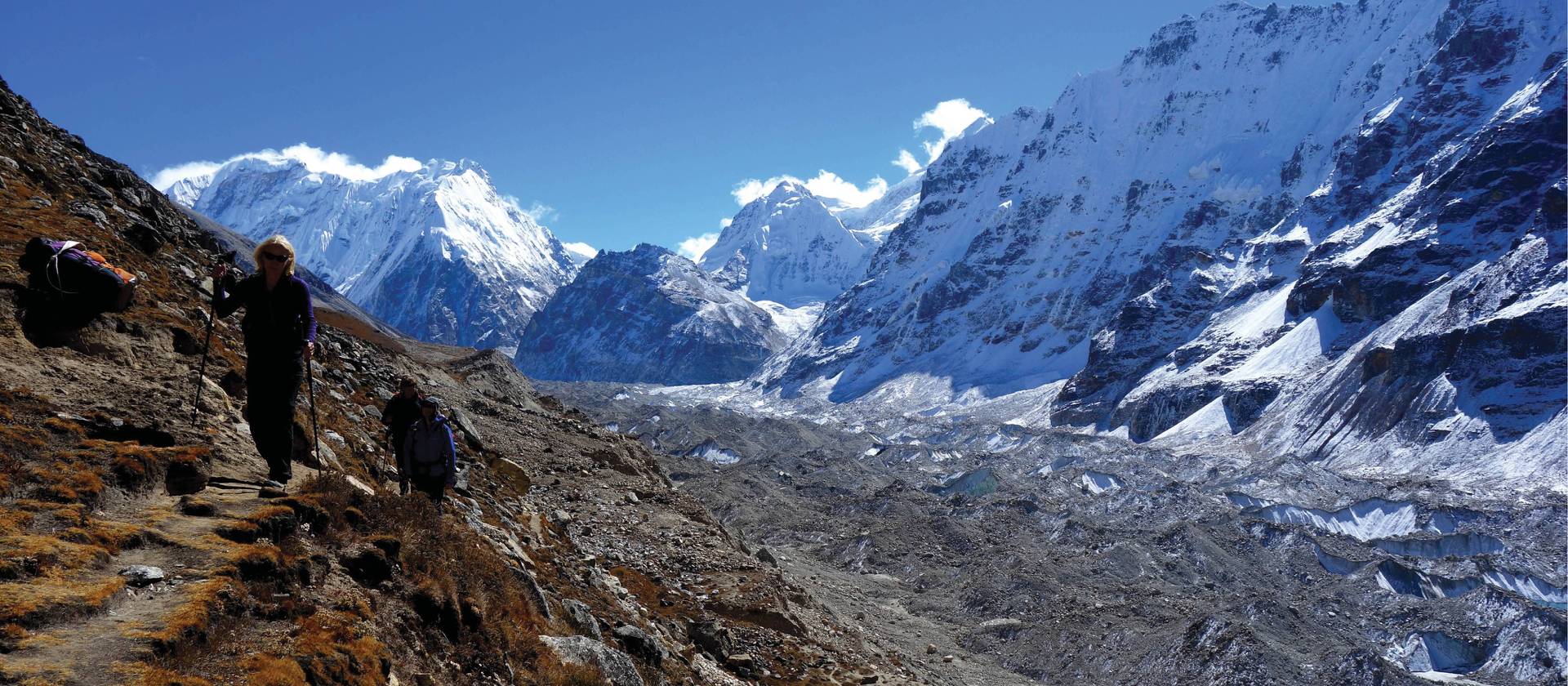
Kanchenjunga Trek
 Duration: 19 Days
 Difficulty: Challenging
 Accomodation: Hotel/ Lodge/ Tea House
 Meal: B-L-D
 Best Seasons: Spring (March-April-May) & Autumn (Sep-Oct-Nov)
Kanchenjunga Trek
Many trekkers consider the 19-day Kanchenjunga Circuit Trek, which delves deeply into the isolated Himalayan peaks on Nepal’s border with Tibet and Sikkim, to be the best wilderness trekking route in the country. The third-highest mountain in the world, Kanchenjunga, is explored by the trek. There are many types of scenery to see. You can find rhododendron, chestnut, and oak forests. There are also lush tropical jungles and, at higher elevations, the alpine zone. You will see Tibetan Buddhist settlements and the cultures of Rai and Limbu. This shows the variety of Nepalese ways of life.
An unbelievable trekking experience is available in the Kanchenjunga region, and now there is a teahouse trek option in addition to the classic full tent trek. This is all the information you require.
The Kanchenjunga trek takes 19 days to reach both base camps of the world’s third-highest mountain. This mountain is 8,586 meters (28,169 feet) tall and sits on the border of Nepal and Sikkim, India. The trek offers stunning views in the remote and rural far-western area of Nepal.
Only the hiking routes in Nepal are included in our carefully thought-out itinerary to Kanchenjunga. The overlooks close to the climbing base camps on the north and south sides of this enormous mountain are the typical trekking sites; traveling between the north and south base camps is also a very pleasurable wilderness experience.
First trek to Kanchenjunga
Kanchenjunga II is the tallest of the five distinct peaks that make up the Kanchenjunga range. Residents of the Kanchenjunga Region revere this mountain, along with the ‘five riches of snow’—gold, silver, diamonds, grain, and holy books. In 1955, British expedition members Joe Brown and George Band became the first to reach the top of Kanchenjunga. The entire range produces four distinct glaciers, which give rise to a few well-known rivers in Nepal that are popular for rafting. This is basic knowledge about Kanchenjunga.
Highlights of the trip
- Discover Nepal’s less-traveled eastern highland areas and stroll by the region’s well-known glacier lakes.
- Fantastic experience exploring the variety of plants and animals
- After your exhausting walks, meditate in the monasteries of Ramtang and Oktang.
- Enjoy yourself immensely on the enormous peaks’ lap.
Detailed Itinerary - Kanchenjunga Trek (19 Days)
Our travel agents will meet you at the Tribhuvan International Airport in Kathmandu and take you to the hotel. Following refreshments, our guide or tour leader will give you a brief overview of your tour.
Today we do preparation for the trip. We take our trekking permits and we do sightseeing in the valley and enjoy the day.
Our tour will pick you up from your hotel after breakfast and take you to the airport. The quick flight to Bhadrapur passes across some of Nepal’s most iconic mountains as well as the Kathmandu Valley and surrounding hills. A complimentary mountain flight! We will go by car to Fikkal/Kanyam, the center of the nation’s tea plantation region, after arriving in Bhadrapur. Then we drive to Taplejung.
The trail follows Ghunsa Khola upstream after descending from Taplejung to the Tamor River Valley. There are stone steps, severe descents, and a few little ascents along the path. It passes through rural communities with farmed terraces of corn and millet as well as subtropical woodlands. Villagers from Limbu and Rai are observed farming or transporting goods in bamboo baskets.
Additionally, you enter the Kanchenjunga Conservation Area on this day; hiking permits are required in this protected area. This stretch is relatively difficult yet beautiful, with trekkers walking along rivers and cliffs and crossing multiple suspension bridges. Particularly in the spring or after rain, there may be a lot of humidity and muddy areas of the trail.
Following Ghunsa Khola, the trail ascends through dense rhododendron and bamboo forests. Numerous suspension bridges and tight cliffside sections on the walk necessitate cautious foot placement. Particularly for novice hikers or those with larger packs, this is one of the more physically taxing days.
This woodland zone is home to animals including Himalayan monals, red pandas, and langurs, but sightings are few. There aren’t many human settlements, although you can come across Tibetan yak herders or makeshift houses used for grazing. Trekking at higher elevations begins at this point, and early symptoms of altitude sickness, such as exhaustion and dyspnea, may manifest.
Following breakfast, we go through various pine, bamboo, rhododendron, and oak forests. We see that the people and communities are starting to resemble Tibet.
Along with a wide variety of birds, we also observe yaks, sheep, and goats on the walk. Following lunch, the trail ascends through thick forest and across a wooden bridge to reach Gyabla, where we spend the night.
The road now passes through woodlands and Phale Village, a settlement for Tibetan refugees established decades ago when Tibetans began escaping China’s communist government.
It’s a winter settlement village now. We have time to go to the village and buy some handicrafts. We travel to Ghunsa, the biggest village in the region, which has a Kanchenjunga Conservation Office, a police station, and a health post. This location offers internet and phone services.
Today, the skyline is dominated by views of the Jannu Himal. We reach a verdant glacier valley after taking a leisurely ascending route. We might be fortunate enough to see snow leopards and blue sheep here. We exercise extra caution in a landslide-prone location where the trail goes past a waterfall.
Once more, we seize the opportunity to prepare for our excursion to the North Base Camp and to acclimate our bodies to the altitude. Today, we can ascend a different ridge that offers breathtaking views of Kanchenjunga.
Today, the trail mostly crosses the Kanchenjunga Glacier’s moraine. There are breathtaking views on both sides of us as we walk uphill over big boulders. We also keep a look out for this uncommon animal because we are deep in Snow Leopard country! Although there are no towns along the road, there are summer yak farms in this area as well.
Today, the trail mostly crosses the Kanchenjunga Glacier’s moraine. There are breathtaking views on both sides of us as we walk uphill over big boulders. We also keep a look out for this uncommon animal because we are deep in Snow Leopard country! Although there are no towns along the road, there are summer yak farms in this area as well. Trekkers typically stay in Lhonak and hike to the base camp as a day trip because Pangpema lacks tea houses due to its remote and untamed position. The location is surrounded by striking glaciers and ice walls, creating a stark yet breathtaking scene. Due to the high altitudes reached on this climb, physical fitness and appropriate acclimatization are crucial.
Today, we retrace our tracks over breathtaking alpine terrain as we descend from Lhonak (5,065 meters/16,617 feet) to Ghunsa (3,475 meters/11,401 feet). The trail continues to show the north face of Kanchenjunga as it passes Ramtang and Kambachen. Even while the descent lessens the strain on your lungs, there are still rocky areas that call for cautious footing. The experience is enhanced by the frequent sighting of wildlife in this isolated valley, including blue sheep and traces of snow leopards. The scenery softens into verdant forest as we descend about 1,600 meters (more than 5,200 feet) in altitude. We reach Ghunsa, a friendly Sherpa community with wooden homes, prayer flags, and a peaceful monastery, by late afternoon.
Today, the trail passes through a forest and along a grassy ridge where we can see Mt. Makalu in the distance along with the settlements of Ghunsa and Phole.
This morning, we set out early in the direction of the Kanchenjunga South Base Camp. The trail leads us up a ridge to Sinelapche La Pass (4,830m) after crossing the Sinion La Pass (4,450m). The views of Mount Kanchenjunga and its valley are breathtaking from this location. The only settlement on this road is Cheram, which we reach by descending along a narrow track. Here, we spend the night.
Today is one of the highlight days of the entire Kanchenjunga South trek. You leave Tseram early, departing along a gradual ascent through the glacial valley. The trail opens up and is scenic, with amazing views of Kabru Range, Rathong Peak, and the Yalung glacier.
After about 2 hours you arrive at Ramche (4,580 m), an incredibly scenic yak pasture surrounded by high peaks. At Ramche the trail turns into rougher terrain as you continue to follow the lateral moraines toward Oktang, or Yalung South base camp viewpoint.
When you reach Oktang (4,740 m) you are rewarded with some of the best close up views of the south face of Kanchenjunga, brutal, not overlooked by Kabru Dome, Kabru south, Kabru North and the massive Yalung glacier. This is as close as you will get to Kanchenjunga from the southern approach.
Take in the stunning panoramic views and take lots of photos, then you turn around and head back the way they came to Tseram.
Overnight in Tseram.
You begin after breakfast with a long descent from an alpine environment down into dense forest. The trek re-traces the path they followed via the Simbuwa Khola valley as you begin to descend gradually then more steeply when you enter dense rhododendron and pine forest.
The path is quite peaceful and quiet as you can hear the river running beside you. On route you’ll pass a number of small rest points before you reach Tortong (2,980 m) a small but scenic settlement nestled in the gorgeous forest. Once you descend below 3,500 m you will notice it is warmer, and the air thicker.
Overnight in Tortong.
Today, we continue further down into the lower hills via the trail, which takes a steep descent towards the valley floor and moves in a comparison of descents and ascents through a thick forest.
You will cross a few suspension bridges, waterfalls and terraced fields as you approach more populated areas of human settlements. The trail opens out ultimately to the big, traditional village of Yamphudin, where most ethnic backgrounds of Sherpa, Limbu, Rai, and Gurung live.
Yamphudin is one of the mostly populated villages on the Kanchenjunga trail, presenting a comfortable place to stay with food and company after many days of remoteness.
Overnight will be in Yamphudin.
After breakfast, you get in a jeep and drive all day, from the mountains to the lowlands. The rough mountain road will become smoother as you make your way down through terraced fields, forests, and busy little hill-top areas.
You will pass through Taplejung and numerous tea-producing regions before arriving at Kanyam, one of the most beautiful and scenic tea-garden areas in eastern Nepal. The green, rolling hills of tea plantations will be a refreshing change from the high mountain landscape you were previously at.
Evening walk around the tea gardens, if you are able to.
Following breakfast, you will drive from Kanyam to Bhadrapur Airport (approx. 1.5-2 hrs) through the fertile plains and warm weather of the Terai region.
You board a short flight from Bhadrapur back to Kathmandu, enjoying the aerial views of eastern Nepal’s hills and plains. After you arrive in Kathmandu you will be transferred to your hotel.
This ends your trek to the Kanchenjunga South Base Camp.
What's Included
Trekking Permits & Entry Fees
- All essential permits required for this region, including the Kanchenjunga Conservation Area Permit (KCAP) and the Restricted Area Permit, arranged and processed by our team.
- Local government taxes and conservation fees included.
Accommodation
- Hotel stay in Kathmandu (2 nights) in a comfortable tourist-standard hotel with breakfast.
- Tea-house/lodge accommodation throughout the trek — clean rooms with standard mountain facilities.
Meals During the Trek
- Three wholesome meals daily during trekking: breakfast, lunch, and dinner.
- Tea or coffee served with breakfast each day.
- Meals include Nepali, Tibetan, and simple continental-style dishes, depending on the lodge.
Professional Team
- English-speaking, government-licensed trekking guide experienced in high-altitude routes.
- Necessary number of strong, insured porters (one porter for every two trekkers).
- Trekking staff insurance including medical & accidental coverage.
Transportation
- All ground transportation as per the itinerary — private vehicles or local jeeps where applicable.
- Domestic flights or road transfers from Kathmandu to the trek starting point (as per your itinerary plan).
Safety & Support
- Basic first-aid medical kit carried by the guide.
- Daily health check and altitude safety briefing.
- Assistance in arranging helicopter evacuation in emergencies (payment not included).
Logistics & Extras
- A complimentary duffel bag, trekking region map, and pre-trek briefing.
- All government taxes, paperwork handling, and service charges.
What's Not Included
Additional Accommodation & Meals
- Extra nights’ accommodation in Kathmandu due to flight delays, early return, or personal reasons.
Personal Costs
- Snacks, desserts, alcoholic beverages, mineral water, and other personal consumables.
Insurance & Emergency Services
- Travel insurance covering high-altitude trekking, medical emergencies, and evacuation (mandatory).
- Helicopter rescue cost, if required.
Tips & Miscellaneous
- Gratitude tips for guide, porter, and support staff.
- Any services not listed in the “Includes” section.
Departure Dates
Route Map & Gallery
Frequently Asked Questions - Kanchenjunga Trek
The Kanchenjunga Trek is located in eastern Nepal, near the border of India (Sikkim) and Tibet, within the Kanchenjunga Conservation Area. It explores the region around Mount Kanchenjunga (8,586m), the world’s third-highest mountain.
The Kanchenjunga Trek is considered challenging. It involves long trekking days, remote trails, limited facilities, and high altitudes, making it suitable for experienced trekkers with good physical fitness.
The highest point of the trek is around 5,140 meters at Lapsang La Pass or near the Kanchenjunga North Base Camp, depending on the itinerary.
A standard Kanchenjunga Trek itinerary takes 20 to 25 days, depending on whether you visit both North and South Base Camps and include acclimatization days.
The best trekking seasons are:
- Spring (March–May) – Clear skies and stable weather
- Autumn (September–November) – Best visibility and dry conditions
Winter is extremely cold, and monsoon season is not recommended due to landslides.
Yes. Trekkers require:
- Kanchenjunga Conservation Area Permit (KCAP)
- Restricted Area Permit
A minimum of two trekkers and a licensed guide are mandatory.
Yes. Since the trek reaches elevations above 5,000 meters, altitude sickness is a real concern. Proper acclimatization, hydration, and a slow ascent are essential.
Accommodation consists mainly of basic teahouses and homestays. In more remote sections, facilities are very limited compared to popular trekking regions.
No. This trek is not recommended for beginners due to its remoteness, duration, and high altitude. Previous high-altitude trekking experience is strongly advised.
Yes. Hiring a government-licensed trekking guide is compulsory due to restricted-area regulations and the remoteness of the region.
Drinking water is available but should be boiled or treated. Charging and internet facilities are very limited or unavailable in many villages.
You will enjoy spectacular views of Mount Kanchenjunga, Jannu (Kumbhakarna), Kabru, Yalung Kang, and other eastern Himalayan peaks.
Yes. The itinerary can be customized to include North Base Camp only, South Base Camp only, or both, along with additional acclimatization or rest days.
The Kanchenjunga Trek is ideal for trekkers seeking a remote, less crowded, and culturally rich adventure with pristine landscapes and authentic village life.
Useful Info
Kanchenjunga Trek Difficulty
Trekking Kanchenjunga is moderate to difficult. You will trek from a jeep trip through villages, forests, and rivers before arriving at the conservation area. You will hike for an average of six to seven hours each day on this easy hike.
One of the best things to do on the Kanchenjunga Trek is to acclimate yourself. This increases our body’s endurance and helps it adapt to the elevated oxygen levels. Therefore, we have ensured that the nighttime trek distance is maintained to ensure a successful walk.
Best time for Kanchenjunga Base Camp Trek
One of Nepal’s most untamed and isolated treks is Kanchenjunga. This will lead you through the conservation areas to the foot of Mount Kanchenjunga. Additionally, there will be fewer communities on the trial, mostly in the area above 3500 meters, because it is the least populous.
The bottom portion of the path experiences intense rainfall during the monsoon, which can cause landslides and flooding in the river and stream. Rainfall typically occurs in June, July, and August through the beginning of September.
In addition, winter will make the Kanchenjunga trip more difficult since snowfall at higher elevations may obstruct the path. Additionally, residents of higher altitudes move to lower altitudes during the winter months of December and January, abandoning their homes.
Kanchenjunga Base Camp Trek Accommodation
Fewer trekkers venture to Kanchenjunga because of its isolation. Nonetheless, this is one of Nepal’s top treks for those who would rather explore the fascinating Himalayas.
The trail won’t be congested and there won’t be as many hikers. The hospitality of the locals is warm and inviting. Their culture and traditions are different from those of other parts of Nepal.
One advantage of this isolated journey is that there are tea establishments all over the place, but less than in other places. Locals are concentrating on providing homestay accommodations for tourists as Kanchenjunga’s popularity grows.
Kanchenjunga Base Camp Trek Cost
Compared to other well-known regions in Nepal, the Kanchenjunga Base Camp Trek is a little pricey. The region is considered secluded and falls to the northern part. The number of days is the first aspect that determines the cost of the Kanchenjunga Base Camp Trek. Additionally, this climb requires special permits in addition to Kanchenjunga Conservation Area Permits because Kanchenjunga is a restricted area. The total cost of the journey will be between $2100 and $2500 per person. However, the cost per passenger decreases as the number of tourists rises.
Book Kanchenjunga Trek with Confidence
Join Top Trail Nepal, your trusted local trekking agency in Kathmandu, for the journey of a lifetime. Our experienced guides, strong safety record, and personal service make your Everest dream come true.

- $2285 1 people
- $2150 2-6 people