


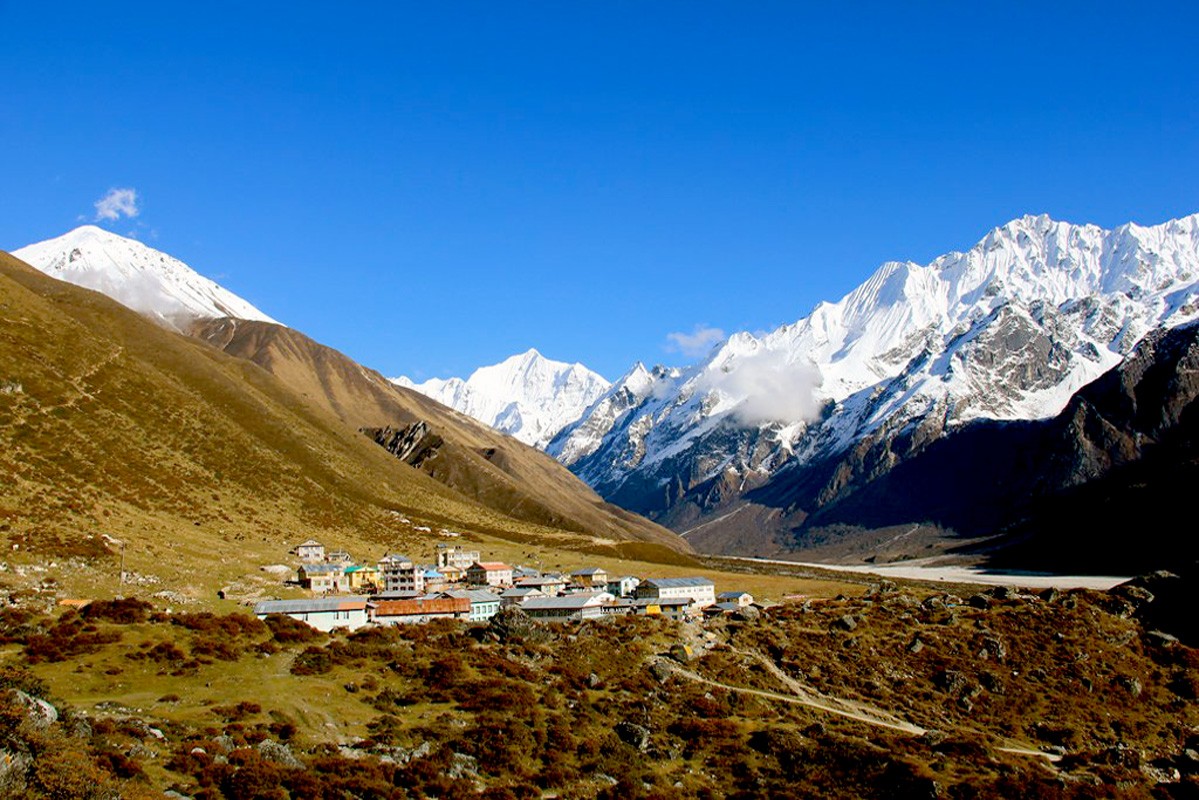
Langtang – Gosainkunda Trek
 Duration: 12 Days
 Difficulty: Moderate
 Accomodation: Hotel/ Lodge/ Tea House
 Meal: B-L-D
 Best Seasons: Spring (March-April-May) & Autumn (Sep-Oct-Nov)
Langtang – Gosainkunda Trek
For those seeking trekking locations close to the Kathmandu Valley, the Langtang Gosaikunda Trek Itinerary is the finest option. The routes allow you to explore the culture and way of life of the Tamang people while passing through their lively villages.
Gosaikunda Langtang Twelve days Trek is located in the Rasuwa district, 52 kilometers north of Kathmandu. Gosaikunda Lake and Kyanjin Gompa, two well-known locations in Langtang, are accessible via the hike.
This trip is a great combination of lovely scenery and gentle trails. For treks to Annapurna and Everest Base Camp, the Langtang Gosaikunda routes are a great substitute. Twelve Days The Langtang The best way to approach the Langtang National Park is through the Gosaikunda Trek. Wildlife, ethnic settlements, high peaks, and many plant and animal species can all be found in the park.
As you stroll around the woodland pathways, you can witness a variety of plants, animals, and birds. Red pandas, musk deer, snow leopards, Himalayan tahr, Ghoral, serow, Daphe, and more are among them. The snow-covered mountains of Dorje Lakpa, Kyunga Ri, Langshisha Ri, Changbu, Langtang Lirung, Gangchenpo, Yansa Tsenji, and more may be seen from the routes.
You get to experience the culture and customs of the Tamang ethnic group, who make up the majority of the Langtang region. These people have a friendly disposition because of the influence of Tibetan customs on their way of life. The Himalayan people are friendly and helpful, extending a warm welcome to visitors and making every effort to provide them with appropriate hospitality. They prioritize the tourists’ comforts and needs over all else.
Overview
Driving from Kathmandu to Syabrubesi via Trishuli Bazaar is the first step in the trek to Langtang Gosaikunda. The next day, you walk to the Lama Hotel and proceed to Langtang village.
You climb to Kyanjin Gompa from Langtang village and settle there. On your day off, you ascend to Tsergo Ri and then head back to Kyanjin Gompa. The next day, you return to the Lama Hotel before traveling to Thulo Syabru.
You then ascend to Singh Gompa and proceed to Gosaikunda Lake. The following day, you go around the lake and make your way down to Chandanbari. You drive back to Kathmandu after making a stop in Dhunche.
Highlights of the trip
- The best way to get away from the crowded paths of the Annapurna and Everest expeditions
- Yala Peak, Langtang Lirung, Dorje Lakpa, Kangchenpo, and other snow-capped summits are beautifully visible.
- Go to the sacred Gosaikunda Lake.
- Hike up to Tsergo Ri and explore the Kyanjin Gompa area.
- Beautiful scenery of the natural world during the trials
Detailed Itinerary - Langtang – Gosainkunda Trek (12 Days)
You get up early, change, eat, and wait in the lobby for the tour. Today, you are traveling 122 kilometers on the Prithvi Highway from Kathmandu to Syabrubesi. As you drive away from the bustling city, you can hear the chirping of birds and the flow of the river. For the initial part of the journey, you pass through a number of tiny towns and villages along the stunning Trishuli River. Along the route, you may also witness stunning farmlands with cattle grazing on them. As you watch these scenes, you arrive at Trishuli Bazaar, a bustling town with a number of motels and eateries.
After breakfast today, you set out to walk 11.3 kilometers (7 miles) from Syabrubesi to the Lama Hotel. Once you leave the settlement, you cross a suspension bridge over the Bhote Koshi River. After that, continue walking down the river until you come to another suspension bridge that leads to the stunning rhododendron woodland. You can witness a variety of animals while strolling through the forest, including wild goats, Himalayan black bears, and leopards. After that, you stroll for a while before arriving to Bamboo, where you eat lunch. As you continue the journey, you pass a number of settlements that have been impacted by Tibetan culture and way of life. There are a number of lodging options for the night in the lovely village of Lama Hotel, which is encircled by forests.
The breathtaking pathways that lead from Lama Hotel to Langtang are breathtaking. The trek is easier today than it was yesterday because the route doesn’t involve a lengthy ascent. You trek up from the Lama Hotel after breakfast, passing the lovely rhododendron orchard. You cross the Langtang River and enter the vibrant area of the forest by strolling outside the grove. The trail gets wider as you proceed, giving you a breathtaking view of the mountains. After there, you continue hiking through the woods until you come to a ridge that crosses the Langtang River and leads to Langtang.
You depart from the village and travel to Kyanjin Gompa after breakfast. You may enjoy some of the breathtaking views of the Himalayas while hiking between these two communities. As soon as you leave, the track crosses pastureland and gradually climbs steeply to Mundo. While Langtang village was being built, a lot of hikers stayed here. After passing through Laja Khola, the route leads to a viewpoint that provides a broad perspective of the Kinshung and Lirung icefalls. After that, you descend a little and arrive at Kyanjin Gompa.
At Kyanjin Gompa, you trek up to Tserko Ri and tour the settlement as part of your initial acclimatization. You get up early, change, and make your way to the historic Gompa. You arrive to the stupa to take part in the morning prayer after a short stroll. Afterwards, you explore the region and take in the stunning views of the surrounding mountains.
After that, you go back to Kyanjin Gompa and eat breakfast. You next start your walk to the top of Tsergo Ri, which is a challenging ascent. Make sure to walk with the group because the routes are not well indicated. You eat lunch there while taking in the scenery before making your way back to Kyanjin Gomp
Like any other day, the journey from the Lama Hotel to Thulo Syabru starts. After eating breakfast and packing your belongings, you resume your journey. You may encounter a group of goats grazing on the land as you descend. You continue downwards after passing them and cross the Langtang River. After that, you proceed into the thick forest of rhododendron, birch, oak, and pine. You reach your target for the day, Thulo Syabru, after hours of walking. You may spend hours exploring the lovely village because it is small and has few residents.
The Langtang Valley walk typically ends at Syabru hamlet, but since you still have to travel to Gosaikunda, you are now heading in the direction of Singh Gompa. You walk the steep path to a stunning stupa after a delectable supper, from which you can see Nagthali and Thurman in the distance.
After walking for hours, you arrive at Forpang Danda, where you halt for lunch. Following the meal, you proceed up the trail, which keeps winding higher through the dense woodland.
As you make your way to the stunning blue lake, it is just another thrilling hiking day. Gosaikunda Lake is a short and reasonably simple trek from Singh Gompa. The journey starts with a leisurely climb through the vibrant forest, where you can see the mountains between the trees. You arrive at Cholongpat and eat breakfast after an hour or two of hiking.
After an additional hour of climbing, you reach the summit of Lauribina, which offers a breathtaking perspective of Ganesh Himal. You then see the lakes for the first time as you climb rapidly forward, past a few high fields, and cross a ridge. The trails take you to Gosaikunda village as you continue to charge on.
The longest and most thrilling trekking day of the trip is today. The difficult Lauribina La Pass (4,610m), the highest point of our journey, will be crossed. To get to the foothills of Lauribina La Pass, we will leave the hallowed location of Gosaikunda and go by a number of other small glacial lakes along the rugged countryside trails. Take a hard trek up to the pass’s summit to witness one of the journey’s most breathtaking views. Watch out for the breathtaking vista of the mountains, which includes the Langtang Lirung Peaks, the Ganesh Himal, and the magnificent Manaslu Peak.
As we travel to Kutumsang, our destination for today, we will enter the Helambu region. To go to Thadepati, begin in the village of Ghopte and follow the trail through a forest with rhododendron and pine incense trees. Along the way, you will encounter rocky paths. Reach the top of the Thadeapti Pass, a difficult climb that will give you breathtaking vistas of the Himalayas, including the Ganesh and Langtang Mountains. Enter the Helambu region after descending from the pass’s crest.
We start our journey by going up the mountain and through verdant forest areas, leaving behind the Sherpa and Tamang-dominated Kutumsang hotel. We next descend to Pati Bhanjyang village, which is home to the Brahmin and Chhetri communities. We will arrive at Chisapani, the trekker’s junction point, after following the meandering track through tiny towns and woodland parts, both uphill and downhill. An additional benefit of being here is the breathtaking view of the sunset over the Himalayan panorama, which includes other peaks as well as Annapurna, Manaslu, and Ganesh Himal to Langtang and Jugal Himal range. Spend the night in Chisapani.
Following breakfast, we will descend the Sundarijal trailhead and ascend a stone stairway into Shivapuri National Park’s natural sanctuary. We will hike through a dense forest full of oak, rhododendron, and pine trees, as well as a watershed and peaceful surroundings, until we arrive at the charming community encircled by a waterfall, a cool setting, and a towering river. Our brief and exciting journey will come to an end when we return to Kathmandu after an hour-long picturesque drive. Spend the night in Kathmandu.
What's Included
- Airport Transfers
- Private airport pick-up and drop-off in Kathmandu with a comfortable vehicle.
- Assistance on arrival at Tribhuvan International Airport.
- Hotel Accommodation in Kathmandu
- Ground Transportation
- Private or shared vehicle transfer from Kathmandu to Syabrubesi and return.
- All land transportation as per the trekking itinerary.
- Meals During the Trek
- Full-board meals throughout the trek: breakfast, lunch, and dinner.
- Teahouse Accommodation
- Lodge accommodation throughout the Langtang Valley and Gosainkunda region.
- Basic but comfortable rooms on a twin-sharing basis.
- Professional Trekking Team
- All Required Trekking Permits
- Langtang National Park Entry Permit
- TIMS Card (if required by current regulations)
- Safety & Medical Support
- First-aid medical kit carried by the trekking guide.
- Basic altitude monitoring and daily health checks.
- Taxes & Service Charges
- All government taxes, conservation fees, and company service charges included.
What's Not Included
- International Travel & Visa
- Travel Insurance
- Personal Trekking Gear
- Personal Expenses
- Hot showers, Wi-Fi, battery charging, laundry services (where applicable).
- Personal shopping and souvenirs.
- Tips for Trekking Staff
- Emergency Evacuation Costs
- Helicopter rescue or medical evacuation expenses
(covered by insurance if properly arranged).
- Helicopter rescue or medical evacuation expenses
- Any Other Costs
- Any services not clearly mentioned in the What’s Included section.
Departure Dates
Route Map & Gallery
Frequently Asked Questions - Langtang – Gosainkunda Trek
The Langtang – Gosainkunda Trek is located north of Kathmandu in the Langtang region of Nepal, combining the scenic Langtang Valley with the sacred Gosainkunda Lake area inside Langtang National Park.
This trek is rated moderate to moderately challenging. It includes steady ascents, high mountain passes, and altitudes above 4,600 meters, making it suitable for trekkers with good fitness and some prior trekking experience.
The highest point of the trek is Lauribina La Pass (4,610 m), located above the sacred Gosainkunda lakes.
The standard itinerary takes 12 to 15 days, depending on acclimatization days, starting point, and route variation.
The best seasons are:
- Spring (March–May) – Blooming rhododendrons and stable weather
- Autumn (September–November) – Clear mountain views and dry trails
Winter trekking is possible but colder; monsoon season is less recommended.
Yes, trekkers need:
- Langtang National Park Entry Permit
- TIMS Card (as per current regulations)
Your trekking company typically arranges all permits.
Yes. Since the trek reaches above 4,500 meters, altitude sickness is possible. Proper acclimatization, hydration, and a gradual ascent help minimize risks.
Accommodation is mainly teahouse-based lodges offering basic but comfortable rooms with shared facilities. Facilities become simpler at higher elevations.
It can be suitable for fit beginners with good preparation, but prior trekking experience is recommended due to altitude and longer walking days.
Yes. Hiring a licensed trekking guide is highly recommended for safety, navigation, altitude management, and cultural insights.
Drinking water is available at lodges or can be boiled or treated. Charging and Wi-Fi are available at some lodges but may require extra payment, especially at higher altitudes.
You’ll enjoy views of Langtang Lirung, Dorje Lakpa, Ganesh Himal, Manaslu range, and surrounding Himalayan peaks.
Yes. The itinerary can be customized by adding acclimatization days, side trips, or combining it with Helambu or other nearby routes.
Useful Info
Weather of Gosaikunda Trek
The Langtang Gosaikunda weather can be unpleasant most of the time, particularly during the season. For comparatively pleasant, cool, and dry weather, the best times to visit Gosaikunda Lake are March through May and September through November. Particularly in the highlands, winter is bitterly cold and frigid; snow causes the landscape to become slick and occasionally treacherous.
Best time to do the Langtang Gosaikunda Trek
Although the Langtang Valley is stunning throughout the year, the best times to go on the Langtang Gosaikunda Trek are in the fall and spring. Autumn, which lasts from September to November, promises pleasant weather, blue skies, and unobstructed views of the mountains. You will be rewarded with the sight of rhododendrons blooming magnificently across the Langtang Valley’s alpine slopes if you choose to travel in the spring, from February to May.
Travelers who are daring will appreciate the enigmatic fog-bound environment and the relative seclusion of the paths during Nepal’s yearly monsoon, which brings heat and heavy rainfall to the valley between June and August.
Accommodation during the Langtang Gosaikunda Trek
Depending on the location, you will often get a simple room with a twin-sharing bed for this voyage. You can get respectable rooms with attached bathrooms in locations like Kyanjin, Langtang, Syabrubesi, and Thulo Syabru village. However, in some locations, including the Lama Hotel, Gosainkunda Lake, Ghopte, and Kutumsang, there are only a few shared rooms with basic amenities, and you may occasionally have to make concessions to other hikers as well.
Food during the Langtang Gosaikunda Trek
The package includes the traditional breakfast, lunch, and dinner meals, which you may customize to include anything from Nepalese dishes like Roti Tarkari and Dhal Bhat to Western dishes like pancakes and spaghettis. In the morning and evening, you will also receive a hot beverage, such tea. You will be responsible for paying for anything else.
Book Langtang – Gosainkunda Trek with Confidence
Join Top Trail Nepal, your trusted local trekking agency in Kathmandu, for the journey of a lifetime. Our experienced guides, strong safety record, and personal service make your Everest dream come true.

- $1085 1 people
- $985 2-6 people
- $885 7-12 people