


Manaslu Trek
 Duration: 13 Days
 Difficulty: Challenging
 Accomodation: Hotel / Lodge / Tea House
 Meal: B -L - D
 Max. Altitude: 5167 m
 Best Seasons: Spring (March-April-May) & Autumn (Sep-Oct-Nov)
Manaslu Trek
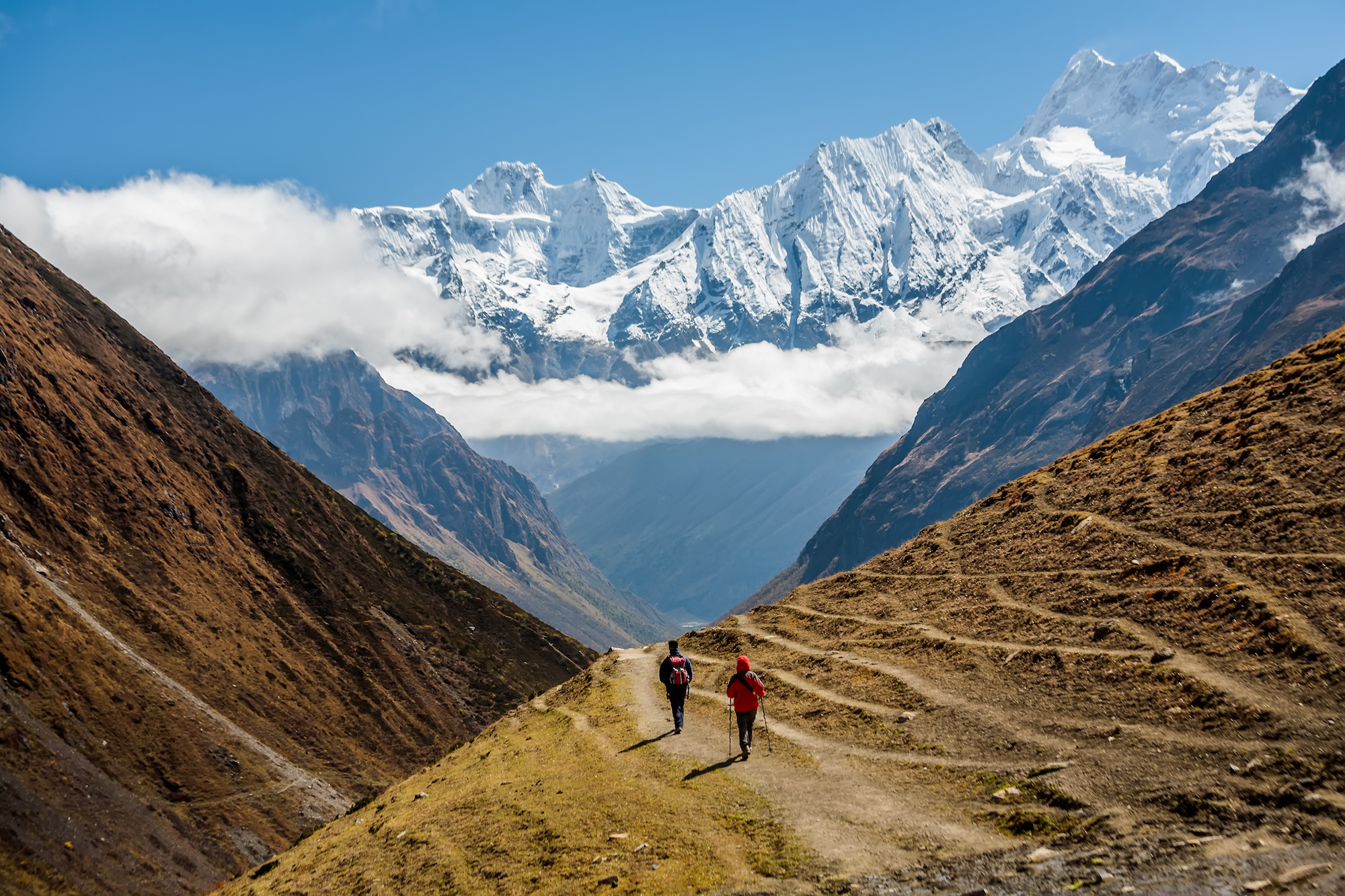
Take this fantastic trip to the Manaslu region in Nepal’s Gorkha district, which is directly on the Tibetan border, to avoid the crowds. The eighth-highest peak in the world is Manaslu. This area has only lately opened to tourists. It offers exposure to Tibetan Buddhist and Hindu cultures. Visitors can also see vistas of breathtaking natural splendor. Many stunning Himalayan peaks may be seen along the walk. These include Himal Chuli (7,893m), Ngadi Chuli (7,871m), and Shringi Himal (7,187m). Other peaks are Langpo (6,965m) and Saula (6,235m). Of course, the famous Manaslu (8,163m) is also visible. In the local tongue, Manaslu is called Kutang. These are just a few of the breathtaking Himalayan peaks that may be seen along the walk. The Sanskrit term Manaslu, which means “mountain of the spirit,” comes from the word Manasa, which means “intellect” or “soul.”
Overview
The track winds through the Budhi Gandaki Valley, starting at Soti Khola and ending at Dharapani. It crosses several rivers en route to the Pungen Glacier and the old Tibetan hamlet at Lho.
A trip to Gorkha, the old Shah Dynasty country with a blend of Buddhist and Hindu cultures, is truly enlightening. Alpine glaciers, waterfalls, and breathtaking flora and wildlife are just a few of the breathtaking natural features this hike has to offer. Larkya La Pass (5106m), which is located directly on the Tibetan border, is the trek’s highest point. With their vivid white, pink, and crimson blossoms, rhododendron woods are vibrant in the spring. The opportunity to observe the solitary way of life of the locals in these inaccessible highland areas is one of the trek’s true attractions.
Visitors will experience amazing animals, geological marvels, the remnants of an ancient civilization, and some of the world’s greatest outdoor experiences as they travel from village to town across difficult terrain. It is home to some of the most breathtaking landscapes and breathtaking wildflower blooms that turn this area into a colorful explosion.
The Manaslu Trekking Adventure is a fantastic combination of many cultures, beautiful landscapes, and geographical wonders. It transports you around some of the world’s tallest peaks, which are more than 8000 meters high. With its breathtaking scenery and difficult journey up to high altitudes, the trip is a complete package for both thrill-seekers and explorers alike. It offers the ideal chance to forget about your problems and worries and fully immerse yourself in this tranquil setting.
Highlights of the place
- Take a unique highway driving journey in Nepal and explore the picturesque hills, riverbank, and highway settlements.
- Explore well-known and tranquil rural communities including Jagat, Soti Khola, Machha Khola, and Arughat.
- Discover the varied rural lifestyle, culture, and religion of the indigenous Nepalese population.
- Savor the cuisine and warmth of the locals while hiking across the high Himalayan slopes and enjoying the comfortable teahouse stays.
- Take detours from Samagaon to the well-known Manaslu Base Camp or Pungyen Gompa.
Detailed Itinerary - Manaslu Trek (13 Days)
Your guide will collect you up from your accommodation at approximately 5:30 am in preparation for our eight-hour road adventure to Soti Khola. The first four hours are spent on sealed roads; however, at Dhading Bensi (1050m), the route becomes unsealed and quite uneven as we go to Arughat and Soti Khola, the district headquarters of Dhading district. We’ll be staying at a guesthouse tonight.
Today, we hike through the forest and head upriver along the Budhi Gandaki River’s banks. After that, we descend to the riverbed and follow a path across the highlands, where we should frequently have vistas of the river below. We’ll be staying at a guesthouse in Machha Khola tonight.
We reach Tatopani, which is well-known for its hot springs, after passing Khorlabesi (920m) and the Machha River. After that, the trail passes through a wooded area on its approach to the Budhi Gandaki Valley and the Dovan Khola (river). You will notice a shift in the environment as we ascend until we reach Jagat Village, where we will spend the night in a hotel.
We travel the trek down the valley to Sirdibas, which offers breathtaking views of the Shringi Himal. Waterfalls tumble down from the mountains on both sides of the valley, and there is a difficult ascent to Philim after crossing a suspension bridge. We continue up through the valley, passing via Ekle Bhatti and Pewa Village before arriving in Deng Village, where we will spend the night in a guesthouse.
After a strenuous ascent this morning, we must return to the Budi Gandaki River. We continue the trail through a number of little villages and the valley. As we approach Namrung, you will notice Mani stones, which are etched with Tibetan mantras and indicate that you are entering Tibetan Buddhist land. We will return to Namrung for our overnight stay at a guesthouse after making a little diversion to Prok hamlet in the afternoon, which will take two hours.
Today, when we stroll between the Mani stone walls of Lho Village, you will feel as like you are traveling back in time. The snow-covered summit of Ngadi Chuli, also known as summit 29, is visible from Lho. We can see Mt. Manaslu up close from the Pungen Glacier after making another quick diversion. In Samagaun, we will spend the night in a guesthouse.
Today, acclimatization is the primary goal before moving on to greater altitudes. It is highly recommended by medical professionals that you continue to be active throughout the day in order to accelerate the process. We can choose to go on a half-day or full-day hike today. You can choose between a half-day hike that will take you to Birendra Ta or a glacier just across the valley, or a full-day trek that will take you to Manaslu Base Camp (4750m), which is a 6–7 hour return trip. We’ll be staying at a Samagaun guesthouse tonight.
Today, we go through the fields before descending to the valley below, where we can enjoy breathtaking views of the trail’s surrounding peaks, particularly Mt. Manaslu. Next, we reach the isolated Tibetan refugee village of Samdo, which is only a short distance from the Tibetan border. You are free to explore the village and surrounding countryside in the afternoon. We’ll be staying at a Samdo guesthouse tonight.
Before reaching Larkya Bazaar, a settlement that serves as a commercial hub for traders traveling down from Tibet, we will need to cross a number of rivers today. After that, we must ascend a tough trek to reach Dharamsala, where we will spend the night in a guesthouse.
As we travel the trail to Bhimthang via Larkya La Pass (5106m/17,121ft), we have a long, difficult day ahead of us. In order to reach the high, snow-covered pass, we must first ascend to Cho Chanda. The views of the numerous nearby peaks are very breathtaking. From the pass, it is easy to see the Himalayan mountains of Himlung Himal (7126m), Cheo Himal (6820m), Gyaji Kung (7030m), Kang Koru (698m), and Annapurna II (7937m). After that, we traverse moraines and descend a rocky trail till we reach Bhimthang Village, where we will spend the night in a guesthouse.
We continue the track through a low alpine woodland this morning as it descends. Going downhill can be taxing on your knees. Our journey is almost over as we are now in the Annapurna Conservation area and near the Annapurna circuit route.
Our journey through the Manaslu region is coming to an end today. We travel from Tilije to Dharapani.
After crossing the Dudh Khola (river), we will go to Besisahar in a local jeep before returning to Kathmandu.
What's Included
- Airport Transfers
- Private airport pick-up and drop-off in Kathmandu
- Assistance at Tribhuvan International Airport
- Hotel Accommodation in Kathmandu
- Ground Transportation
- All land transportation as per itinerary
- Private or shared jeep/bus from Kathmandu to Soti Khola / Machha Khola and return from Besisahar / Dharapani
- All local transfers included
- Meals During the Trek
- Full-board meals throughout the trek
- Teahouse Accommodation
- Lodge-based accommodation throughout the Manaslu region
- Basic but clean rooms on a twin-sharing basis
- Professional Trekking Team
- All Required Trekking Permits
- Manaslu Restricted Area Permit (RAP)
- Manaslu Conservation Area Permit (MCAP)
- Annapurna Conservation Area Permit (ACAP)
- TIMS Card (if required under current regulations)
- Safety & Medical Support
- First-aid medical kit carried by the guide
- Basic altitude monitoring and daily health checks
- Government Taxes & Service Charges
What's Not Included
- International Travel & Visa
- Travel Insurance
- Personal Trekking Equipment
- Personal Expenses
- Hot showers, Wi-Fi, battery charging, laundry services (where applicable)
- Personal shopping and souvenirs
- Tips for Trekking Staff
- Emergency Evacuation Costs
- Helicopter rescue or medical evacuation if required
(covered by insurance if properly arranged)
- Helicopter rescue or medical evacuation if required
- Any Other Costs
- Any services not specifically mentioned in the What’s Included section
Departure Dates
Route Map & Gallery
Frequently Asked Questions - Manaslu Trek
The Manaslu Trek, also known as the Manaslu Circuit Trek, is a remote Himalayan trekking route that circles Mount Manaslu (8,163m), the eighth-highest mountain in the world. It is known for its dramatic scenery, cultural villages, and fewer crowds compared to Everest and Annapurna.
The Manaslu Trek is located in north-central Nepal, near the Tibetan border, within the Manaslu Conservation Area and partially through restricted regions.
The Manaslu Trek is considered moderate to challenging. It involves long walking days, high altitude, and crossing a high mountain pass, making it suitable for trekkers with good fitness and prior trekking experience.
A standard Manaslu Circuit Trek itinerary takes 14 to 18 days, depending on acclimatization days, route variation, and walking pace.
The highest point is Larkya La Pass (5,160 meters), one of the most scenic and challenging passes in Nepal.
The best seasons for the Manaslu Trek are:
- Spring (March–May) – Pleasant temperatures and blooming rhododendrons
- Autumn (September–November) – Clear skies and excellent mountain views
Winter is colder with heavy snow, and monsoon season is not recommended.
Trekkers need multiple permits:
- Manaslu Restricted Area Permit (RAP)
- Manaslu Conservation Area Permit (MCAP)
- Annapurna Conservation Area Permit (ACAP)
All permits are arranged through a registered trekking agency.
Yes. The trek reaches elevations above 5,000 meters, so altitude sickness is a potential risk. Proper acclimatization, hydration, and a gradual ascent are essential.
Accommodation is mainly teahouse-based lodges offering basic but comfortable rooms. Facilities become more basic at higher elevations.
Yes. The Manaslu region is a restricted area, and trekking is only permitted with a licensed guide and through a registered trekking company.
The Manaslu Trek is not ideal for first-time trekkers. Previous high-altitude trekking experience is strongly recommended due to its remoteness and altitude.
Limited Wi-Fi and charging facilities are available in some villages, but service is unreliable and often unavailable in higher or remote areas.
Trekkers can enjoy views of:
- Mount Manaslu (8,163m)
- Himalchuli, Ngadi Chuli, Ganesh Himal, and surrounding peaks
Yes. The Manaslu Trek itinerary can be customized with additional acclimatization days, side hikes, or by combining it with Tsum Valley based on your preferences.
Useful Info
Best time for the trek
The Manaslu Trek is typically completed in the fall (September to November) and spring (March to May), when you may appreciate the lush foliage in the lower portions of the trail, especially in the spring, and are far more likely to have pristine views of the mountains.
Accommodation during the trek
In Kathmandu, you will stay in three-star hotels. We will be lodging at lodges and teahouses throughout the journey. At lower elevations, you could discover cozier and higher-quality teahouses. It should be mentioned that the quality of lodging may be worse at higher elevations, with simpler rooms that just have the minimal necessities.
Fitness during the trek
Walking for six to eight hours a day can be difficult on some days. Although prior hiking or trekking experience is not required, it is usually an advantage if you have done any form of trekking! We have encountered individuals who have finished the journey of different sizes, shapes, and backgrounds. The only challenging aspect is dealing with altitude sickness and its potential physical effects. It is good to physically prepare oneself before traveling to Nepal by boosting your oxygen intake and stamina.
Transportation during the trek
For touring and for pickup and drop-off from the airport to the hotel, we utilize a private vehicle. From Bensisahar, we travel to Kathmandu by bus. The trip used to begin at Aarughat, but because to improved road conditions, we can now take a bus straight to Soti Khola. We will take a local bus to Soti Khola via secondary (difficult) roads, then we will take a private vehicle from Dharapani to Besishahar.
Book Manaslu Trek with Confidence
Join Top Trail Nepal, your trusted local trekking agency in Kathmandu, for the journey of a lifetime. Our experienced guides, strong safety record, and personal service make your Everest dream come true.

- $1385 2 people
- $1290 3-6 people
- $1250 7-12 people