


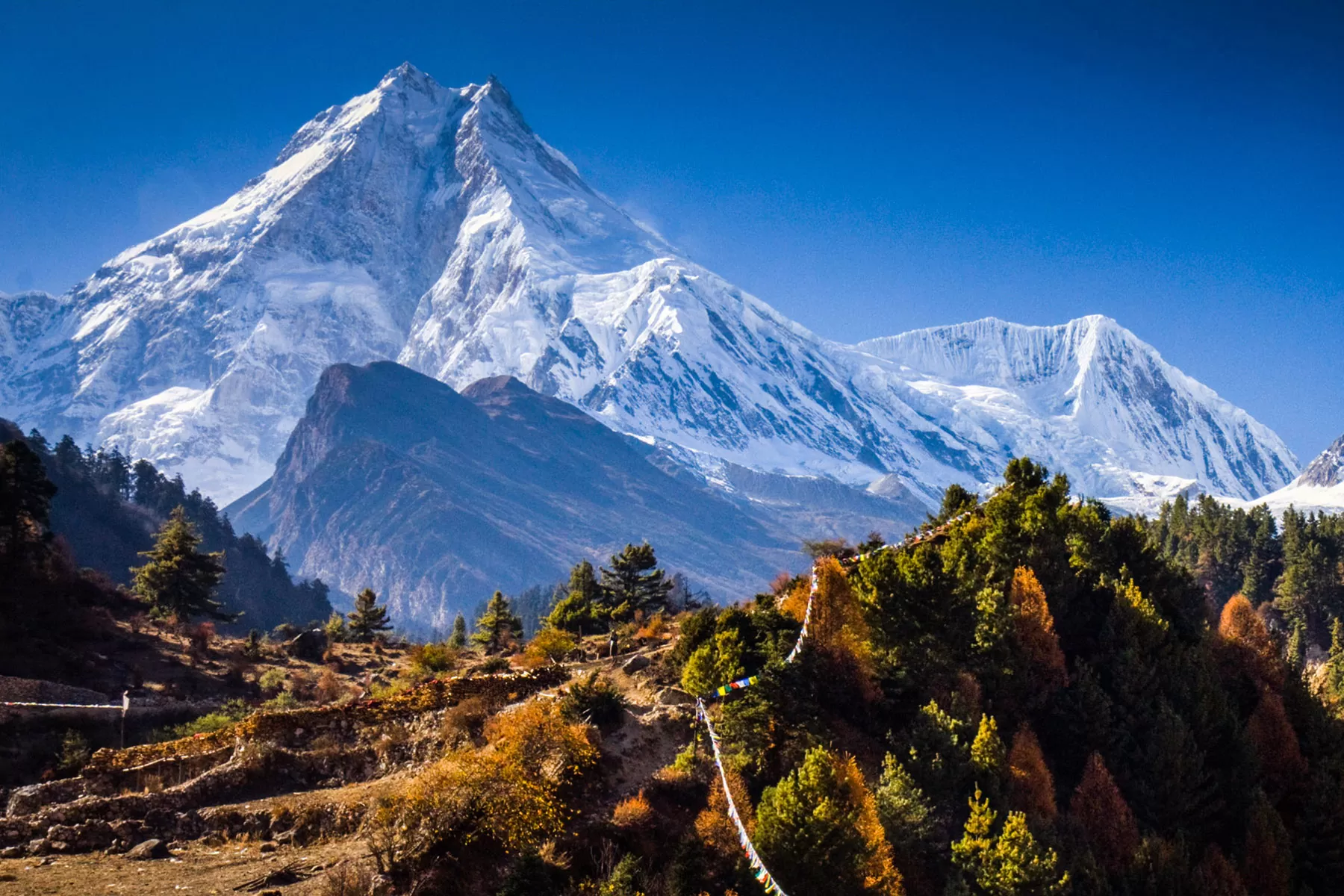
Manaslu Tsum Valley trek
 Duration: 18 Days
 Difficulty: Challenging
 Accomodation: Hotel/ Lodge/ Tea House
 Meal: B-L-D
 Max. Altitude: 5167m
 Best Seasons: Spring (March-April-May) & Autumn (Sep-Oct-Nov)
Manaslu Tsum Valley trek
We go on an unparalleled trip with the Manaslu Tsum Valley Trekking. It depicts a voyage to some of the most captivating, appealing, and majestic High Himalaya peaks and mountainscapes around Manaslu and blends it with the magical landscapes of(Hidden Valley) Tsum Valley. One of the primary attractions of our Manaslu Tsum Valley Trek will undoubtedly be Mount Manaslu, the eighth highest peak in the world.
Tsum Valley’s Tibetan Buddhist charm is also immensely revitalizing. We start our journey, driving to ASoti Khola from Kathmandu where the hike beginning site. We hike beyond the Budhi Gandaki River to the settlement of Machhakhola, passing through charming little villages and terraced farms. After that, the hike to Tatopani passes through forests and tiny towns where you can have a few relaxing hot spring baths. The Stunning Views of Mt. Sringi Himal joins us on the journey to Philim.
Trekking through Chumling we arrive Chhokangparo in the Upper Tsum Valley with amazing views of Mt. Ganesh Himal, Mt. Boudha Himal, and Mt. Himal Chuli. In the trail to Nile/Chhule, we pass across Piren Phu (pigeon cave), a sacred destination that preserved Buddhist murals, calligraphy, and old carved stones where we halt for visit.
After stopping at Mu Gompa at 3700 meters, we hike to the nunnery at Rachen Gompa. The hike to Gumba Lungdang runs through pine and colorful rhododendron trees and we cross the Siyar Khola. If you have adequate time you can take a rest to visit Ganesh Himal Base Camp. The trail to Chumling, our following day destination has no appropriate lodging or services, so we start early. We walk through the villages of Gurung and Thakali on our way from Chumling to Deng. After resting for a day in Samagaon, we trek to Manaslu Base Camp or Pungiyan Gompa and tour the village.
From Samagaon, we progressively ascend to Samdo, Dharmasala, and then cross the Larke La pass at 5106 meters to reach Bhimtang, where the journey comes to a close. Following that, we will set off to return to Kathmandu via Bashisahar.
Highlights of the trek
- Discover the friendly hospitality of the people who are protecting the old Tibetan Buddhist culture.
- See ancient monasteries like as Rachen Gompa and Mu Gompa.
- If the timing is right, participate in regional celebrations like Losar (Tibetan New Year).
- Travel through glacial rivers, alpine meadows, verdant subtropical jungles, and terraced farmland.
- Savor breathtaking views of Ganesh Himal, Himalchuli, Mount Manaslu (8,163 meters), and other peaks.
Detailed Itinerary - Manaslu Tsum Valley trek (18 Days)
Our agent will pick you up from the airport and drive you to your accommodation. If you have the time, we can show you around Thamel and assist you in purchasing any equipment you might need for your journey.
Today, we go through Dhading Beshi and Arughat on our way from Kathmandu to Soti Khola. The road deteriorates and is quite poor and bumpy from Dhading to Arughat. This afternoon, we follow a road through the trees that leads upriver along the Budhi Gandaki River’s banks before crossing the mountains, from which we frequently get views of the river far below. We’ll be staying at a guesthouse in Machha Khola tonight.
Today we pass the Machha Khola River and pass Khorlabesi (920m) before arriving to Tatopani, known for its therapeutic hot springs. The trail next travels through a forested area as we make our approach to the Dovan Khola (river) and to the Budhi Gandaki Valley. As we climb higher you will notice a shift in the environment right up until we get to Jagat Village where we will stay at a guesthouse overnight.
Today we go off on a 6-hour hike, first reaching Salleri where we have amazing views of Mount Sringi before going to Sirdibas, a traditional Buddhist village. The trail continues till we reach Lokpa Village, just north of Philim and then travel via Ekle Bhatti and rise to a ridge along a trail through a pine grove. We get to a junction where we pick the trail headed to Tsum Valley. We spend the night at Lokpa.
Today we have a 5-hour hike ahead of us to Tsum Valley. As we descend to the mountainous Chumling Village, the first views of Tsum Valley emerge. We next walk up to Ripchet and a short time later reach the true Buddhist settlement of Chumling, well known for its historic monastery, traditional Tibetan style dwellings, prayer flags, mani walls, and its stone-paved streets. We sleep here overnight.
Today we start our 5-hour hike by crossing a suspension bridge and we have great views of the Ganesh Himal. Before reaching Gho Village, the trail continues past Rainjam and across Seru Khola. We hike for five to six hours before arriving at Chokhangparo Village, where we can see the Ganesh Himal (7140m) and Himalchuli (7893m). Tonight, we remain here. Included are breakfast, lunch, and dinner.
The six to seven-hour walk today follows the path to the Shir Khola (river) and Rachen Gompa. After exiting the river, we go via the towns of Phurbe and Pangdun before reaching the Nile, where we spend the night. Mu Gompa is the highest peak in the Tsum Valley and the biggest monastery in the area. Included are breakfast, lunch, and dinner.
From Gompa, the decline begins. We make our way down to Rachen Gompa, Chhule, and finally Phurbe. Rachen Gompa situated in the border area of Nepal and Tibet, and it rests surrounded by huge mountains. But the objective for this day takes you through a forested area and finally reaches Chhokangparo.
Following breakfast, we continue to descend from Chhokung Paro till we get at Gho. To go to Rainjam Village, you will need to cross a suspension bridge close to Gho and continue hiking. We leave Rainjam village, descend to Tsum Valley and finally reach Chumling – our target for the day.
We must first cross a suspension bridge before descending from Chumling to Lokpa, which will take six to seven hours. We have a fantastic view of the Sringi Himal as the trail winds around a steep peak. Next, we travel through Ghatta Khola, passing by farms that cultivate vegetables, potatoes, millet, and maize. We go along the Budhi Gandaki’s bank, passing through a bamboo forest until arriving at the Deng River. Tonight we stay at Deng adjacent to the river.
Today we initially have an uphill trek and then have to descend back down to the Budi Gandaki River. The trail heads through the valley and past several tiny towns. As we approach Namrung, you will notice Mani stones, which are etched with Tibetan mantras and serve as a reminder that we are entering Tibetan Buddhist country. In the afternoon we will take a short and interesting detour to Prok hamlet (2 hour round journey) and then follow the trail to Namrung for our overnight stay at a guesthouse.
Walking between the Mani stone walls of Lho Village, a location with little indications of civilization, is like traveling back in time. The snow-capped summit of Ngadi Chuli (7871m, also known as summit 29) is visible from Lho. We take a quick diversion up to the Pungen Glacier, where we can see Mt. Manaslu in breathtaking detail. We’ll spend the night at a Samagaun guesthouse.
Before attempting climbs to greater elevations, it is required to acclimate to these higher altitudes for at least one day. Health doctors urge that you move about and don’t sit idly. A nice approach to stay active is to explore the gompa at Pugyen(4070m), a one day climb that exits the path between Syaula and Sama. If time permits, it is possible for you to proceed on up this valley to the difficult rocks and terrain of the Pugin glacier. A journey to the lake at Birendra Tal (3450m) and a strenuous climb to Manaslu Base Camp (4900m) are two more options. Milarepa’s Cave (renowned Buddha) is thought to be located north of Birendra Tal and is said to have served as a meditation retreat for the Buddhist saint. Lunch, supper, and breakfast.
Before arriving at Larkya Bazaar, a settlement that endures as a commercial post for traders traveling down from Tibet, we cross a number of rivers this morning. From here we ascend up a hard trail till we reach to Dharamsala where we will stay overnight in a guesthouse.
We have a challenging day ahead of us as we travel the trek across Larkya La Pass (5106m/17,121 ft) to Bhimthang. We must first ascend to Cho Chanda before reaching the high, snow-covered pass. The vistas of numerous surrounding peaks are very excellent from this high altitude vantage point. The Himalayan mountains of Himlung Himal (7126m), Cheo Himal (6820m), Gyaji Kung (7030m), Kang Koru (698m) and Annapurna II (7937m) are vividly observable from the pass. After that, we hike past moraines and descend a difficult trail to Bhimthang Village, where we will spend the night at a guesthouse.
Today, we cross the Dudh Khola (river) on a suspension bridge after descending from high grazing area. Along the trail we walk past rhododendron (flowering in spring) and oak trees. We reach Dharapani in the Annapurna region after a six to seven-hour hike. Additionally, this is a popular starting point for the Annapurna circuit hike. If you are thinking about extending your walk, then we can head down the Annapurna trail. Tonight we stay at a guesthouse in Dharapani.
Today marks the last day of our walk over the Manaslu Circuit. Across the river, we will take a local jeep to Besisahar and then a bus back to Kathmandu where you will be brought back to your lodgings.
You will leave Nepal, but will never forget this fantastic trip and the laughs you shared on your tour to some of the world’s most stunning peaks. We’ll drop you off to the airport.
What's Included
- Airport Transfers
- Private arrival and departure transfers in Kathmandu.
- Assistance at Tribhuvan International Airport.
- Hotel Accommodation in Kathmandu
- Ground Transportation
- Private or shared transportation from Kathmandu to the trek starting point (Soti Khola / Machha Khola) and return.
- All land transfers as per the trekking itinerary.
- Meals During the Trek
- Full-board meals during trekking days: breakfast, lunch, and dinner.
- Tea or coffee served with breakfast.
- Freshly prepared meals at local teahouses along the trail.
- Teahouse Accommodation
- Lodge-based accommodation throughout the Manaslu and Tsum Valley region.
- Basic but clean teahouse facilities on a twin-sharing basis.
- Experienced Trekking Staff
- All Required Trekking Permits
- Manaslu Restricted Area Permit (RAP)
- Tsum Valley Restricted Area Permit
- Manaslu Conservation Area Permit (MCAP)
- Annapurna Conservation Area Permit (ACAP)
- TIMS Card (if required by updated regulations)
- Safety & Medical Support
- First-aid medical kit carried by the guide.
- Basic altitude monitoring and daily health checks.
- Staff Insurance & Welfare
- Comprehensive insurance coverage for all trekking staff, including emergency rescue.
- Government Taxes & Service Charges
- All official taxes, conservation fees, and company service charges included.
What's Not Included
- International Travel & Visa
- Travel Insurance
- Personal Trekking Equipment
- Extra Drinks & Snacks
- Personal Expenses
- Wi-Fi, hot showers, battery charging, laundry services (where applicable).
- Personal shopping and souvenirs.
- Tips for Trekking Staff
- Emergency Evacuation Costs
- Helicopter rescue or medical evacuation expenses
(covered by insurance if proper coverage is arranged).
- Helicopter rescue or medical evacuation expenses
- Any Other Costs
- Any services not specifically mentioned in the What’s Included section.
Departure Dates
Frequently Asked Questions - Manaslu Tsum Valley trek
The Manaslu Tsum Valley Trek is a remote cultural and Himalayan trekking route in Nepal that combines the Manaslu Circuit with the sacred Tsum Valley, known for ancient monasteries, Tibetan culture, and pristine mountain landscapes.
The trek is located in north-central Nepal, near the Tibet border, within the Manaslu Conservation Area and the restricted Tsum Valley region.
The trek is considered moderate to challenging. It involves long trekking days, high altitude, and remote terrain, making it suitable for trekkers with good fitness and prior trekking experience.
A standard itinerary takes 18 to 22 days, depending on acclimatization days, side trips, and walking pace.
The highest point is Larkya La Pass (5,160m), which is crossed during the Manaslu Circuit section of the trek.
The best trekking seasons are:
- Spring (March–May) – Mild weather and blooming rhododendrons
- Autumn (September–November) – Clear skies and stable conditions
Winter is colder with snow, and monsoon season is not recommended.
You will need multiple permits:
- Manaslu Restricted Area Permit (RAP)
- Tsum Valley Restricted Area Permit
- Manaslu Conservation Area Permit (MCAP)
- Annapurna Conservation Area Permit (ACAP)
All permits are arranged by the trekking company.
Yes. The trek reaches elevations above 5,000 meters, so altitude sickness is possible. Proper acclimatization, hydration, and a gradual ascent are essential for safety.
Accommodation is mainly teahouse-based lodges, offering basic but clean rooms. Facilities are simpler in the Tsum Valley compared to more commercial trekking regions.
This trek is not recommended for beginners. Previous trekking experience at high altitude is strongly advised due to its length, remoteness, and elevation gain.
Yes. The Manaslu and Tsum Valley regions are restricted areas, and trekking must be done with a licensed guide through a registered trekking agency.
Limited internet and charging facilities are available in some villages, but service is unreliable and often unavailable in higher and remote sections.
Yes. The itinerary can be customized with additional acclimatization days, monastery visits, side hikes, or shorter/longer trekking options based on your preferences.
Useful Info
Best time for the trek
The Manaslu Circuit Trek is typically completed in the fall (September to November) and spring (March to May), when you may appreciate the lush foliage in the lower portions of the trail, especially in the spring, and are far more likely to have pristine views of the mountains.
Accommodation during the trek
In Kathmandu, you will stay in three-star hotels. We will be lodging at lodges and teahouses throughout the journey. At lower elevations, you could discover cozier and higher-quality teahouses. It should be mentioned that the quality of lodging may be worse at higher elevations, with simpler rooms that just have the minimal necessities.
Fitness required for the trek
Walking for six to eight hours a day can be difficult on some days. Although prior hiking or trekking experience is not required, it is usually an advantage if you have done any form of trekking. We have encountered individuals who have finished the journey of different sizes, shapes, and backgrounds. The only challenging aspect is dealing with altitude sickness and its potential physical effects. It is good to physically prepare oneself before traveling to Nepal by boosting your oxygen intake and stamina.
Guide and Porter on the trek
We offer you a porter for every two hikers, each of whom will carry roughly 20 kilograms (10 kg for each trekker), as well as qualified and licensed trekking guides and porters who will handle all logistics. Success or failure will depend on having a skilled porter and guide. Additionally, they will prevent you from taking needless chances when bad weather strikes.
Book Manaslu Tsum Valley trek with Confidence
Join Top Trail Nepal, your trusted local trekking agency in Kathmandu, for the journey of a lifetime. Our experienced guides, strong safety record, and personal service make your Everest dream come true.

- $1690 2 people
- $1585 3-6 people
- $1490 7-12 people