


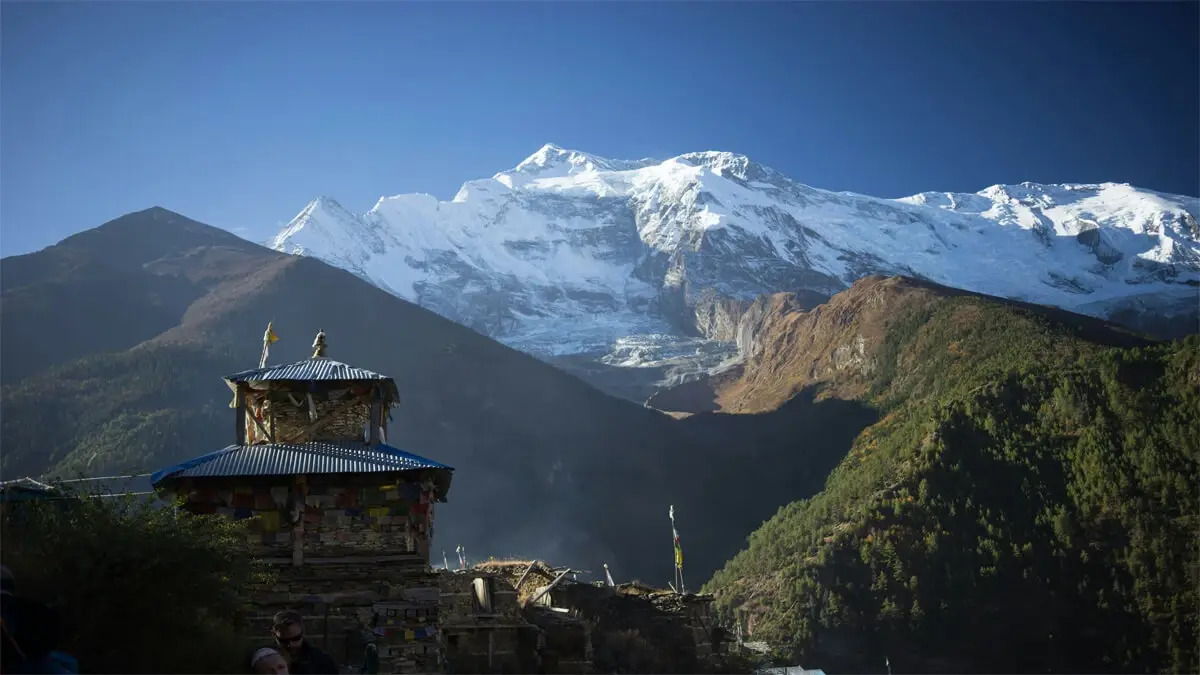
Narphu Valley – Kang La Pass – Chulu East Peak Trek
 Duration: 16 Days
 Difficulty: Strenuous
 Accomodation: Hotel/ Lodge/ Tea House
 Meal: B-L-D
 Max. Altitude: 5320m
 Best Seasons: Spring (March-April-May) & Autumn (Sep-Oct-Nov)
Narphu Valley – Kang La Pass – Chulu East Peak Trek
This 16-day Nar Phu Valley trek takes you to remote villages like Phu and Nar. These places are rich in Tibetan culture. The trek goes through deep valleys and tall hills. You will also cross high altitudes, like Kanga La Pass (5322m). This area is rarely visited by tourists. The more daring hiker will enjoy this area’s pristine environment and unspoiled state. The Nar Phu valley has amazing views of huge peaks. These include Gangapurna (7455m), Annapurna II (7937m), Himlung Himal (4900m), and Tilicho Peak (7134m). They are located between the famous Annapurna and Manaslu regions.
You can experience ancient, unspoiled Tibetan villages rich in history and traditional Buddhist culture by trekking to the Nar Phu Valley. When you visit the tea houses and lodges, you will be warmed by the genuinely friendly and welcome grins of the predominantly Mongolian residents. The surrounding terrain and lofty mountains stand in sharp contrast to the verdant pastures where yaks graze. There are numerous chortens (Buddhist shrines/monuments), gompas (monasteries or temples), mani walls (stone walls that form a six-symbol prayer), and Tashi Lhakhang Buddhist monastery in Marpha Village because the area is primarily Buddhist. You will have the opportunity to unwind at Tatopani’s healing hot springs near the end of the hike.
Experience Overview
High altitudes, limited rocky terrain, and some steep rising paths can make the Nar Phu Valley walk difficult at times. The trail passes through both desert and lush forests with breathtaking peaks in front of you. As you follow the trail, you will unexpectedly enter some secret valleys with their distinctive Tibetan-style architecture and stone structures. This walk is a once-in-a-lifetime experience because of the stunning scenery and Tibetan Buddhist settlements in this isolated, remote location.
We start the walk from either Chame or Dharapani after driving from Kathmandu. The Annapurna Circuit Trail to Koto, then up to Meta, where we bridge the Marsyangdi River and enter the Nar Phu Valley. We enjoy amazing views of Mt. Kang Guru (6981m) and Mt. Pisang (6091m) as we move into the valley’s more open areas. The trail passes the unusual blue sheep and yaks grazing in these alpine areas, as well as several small, unspoiled Tibetan communities with their distinctive religious structures.
After passing through Nar, we cross the Kang la Pass (5322m) and arrive to Tilicho Base Camp (5000m), where we can see the breathtakingly high Annapurna II (7937m), Gangapurna (7455m), and Tilicho Peak (7134m). We can now choose to ascend to the blue Tilicho Lake (4920m), pass Mesokanto La Pass (4919m), and continue on to Jomsom. Before continuing on to Pokhara and ultimately returning to Kathmandu, we take a leisurely bathe in the Tatopani Hot Springs as our final stop on the journey.
Highlights of the trek
- Discover the way of life of the Mongolian Tibetan people in this remote area close to Tibet.
- Take in the breathtakingly rough and untamed scenery, which includes cloud-covered mountains.
- Surrounded by large mountain ranges, including the massive peaks of Annapurna, Dhaulagiri, and Manaslu.
- Explore historic Buddhist monasteries.
- Reach the summit of Mesokanto La Pass (4919m) and Kang La Pass (5322m).
- The weathered, amiable faces of Tibetan Buddhists in isolated areas dressed in traditional garb.
Detailed Itinerary - Narphu Valley – Kang La Pass – Chulu East Peak Trek (16 Days)
On your first day in Kathmandu, you will arrive at Tribhuvan International Airport, be driven to your accommodation, and have time to relax or explore Thamel, a popular tourist area. A welcome supper or a briefing with your trip leader may be part of the evening, depending on your itinerary. If necessary, there may then be some last-minute shopping.
By jeep or bus, it is possible to go from Kathmandu to Koto in a single day; the trip usually takes nine to ten hours. There are two phases to the trip, each with a separate set of roads.
Kathmandu to Besisahar: This leg takes about 6-7 hours and is on a paved road (Prithvi Highway), albeit it can occasionally be bumpy and narrow due to ongoing construction.
Besisahar to Koto (2,600m): Due to the unsealed, uneven, and off-road nature of the route, you will need to switch to a 4×4 jeep. This part takes an additional three to four hours.
A strenuous yet breathtaking part of the Nar Phu Valley trek, the walk from Koto to Meta takes you away from the main Annapurna circuit trail and into a secluded, isolated Himalayan setting.
With stunning high-mountain views, today’s hike takes you more into the isolated Phu Valley. Following the river upstream, the footpath separates toward Nar or Phu at Junction (3,700m). You will come across a number of old mani walls and prayer flags, which are indicators of Tibetan Buddhism. With tall cliffs and sporadic glimpses of blue sheep, the terrain gets increasingly dry. At last, you reach Phu Gaon, a secret medieval town with stone homes, a Tashi Lhakhang Gompa from the fifteenth century, and breathtaking views of the Himlung Himal (7,126m).
You’ll spend a day touring Phu Gaon to get used to the altitude. A quick trek to higher vantage points (4,500m+) provides expansive views of the valley and neighboring peaks. You can go to the historic monastery, talk to people of Tibetan heritage, and see how they live. Some hikers investigate the remnants of ancient forts (dzongs) or go on an optional excursion to the adjacent glaciers. The day aids in your body’s preparation for the strenuous journey to Nar.
After leaving Phu, you go back to the Junction (3,700m) and then take a detour in the direction of Nar. The road progressively rises, passing through yak herders’ camps and high-altitude fields. With far-off snow-capped peaks and wind-carved rock formations, the scene is harsh but lovely. The village of Nar looks like a mirage as you get closer, with a collection of stone homes with flat roofs encircled by fields of buckwheat and barley. With its own historic gompas and a significant Tibetan influence, Nar has a rich cultural heritage.
You don’t have to walk much on the sixth day of the expedition. The walk takes only three hours. Such significant highlights do not exist in the area. The path is rocky and quite dry. We will eat lunch once we arrive in Nar Village because the journey is short.
/>/>/>The large village of Nar is located in a remote and restricted region of Nepal. There are about a hundred local homes. The majority of the population in the area is Tibetan and Sherpa. The residences have a wide variety of designs. One house appears to be built on top of the other, and so on.
Among the several days of the Nar Phu Valley Trek, this one is likely to be extremely difficult and lengthy. On this day, we must travel to Kang La Pass, a high pass. From Nar village, it takes five to six hours to get to Kang La Pass. Since we will be reaching a high altitude, the route up to the Kang La Pass is difficult. The elevation of Kang La Pass is 5320 meters. From the high pass, we can see the entire Annapurna range, the Himlung Himal, and even Manang’s Humde Airport.
On this day, we will pack a lunch and eat it in Kang La Pass. We will travel to Ngawal after taking a short break. Due to the high snowfall and steep drop on the way to Nawal, passing the Kang La Pass in the winter is extremely difficult.Ngawal can be reached from Kang La Pass in about three to four hours. Ngawal’s teahouse will be our lodging.
The Annapurna region contains the large settlement of Ngawal. An ideal way to begin the day is to visit a stunning Gompa in the heart of the hamlet. There are a few tiny cafes here where you may also enjoy some baked products. We will have plenty of time to take in the views and sunrise because today’s walk is short. Today, we will trek from Yak Kharka to the Chulu East Base camp.
For those traveling from Yak Kharka to the base camp, there may be some really difficult parts of the walk due to the significant elevation gain in the short distance. We’ll take a quick break in the middle to have lunch. This route offers amazing views. We will arrive at Chulu East’s base camp in the afternoon by walking steadily uphill. We will camp there and then take a nap for the day. Spend the night at Chulu East Base Camp.
At a height of more than 5,000 meters, today is an essential rest day. Snow from the base camp has mostly covered the path and its surrounds. Tomorrow, you can take a quick hike to see the scenery and analyze the climb. Examine the equipment and get ready for the next day’s summit. Today, we shall eat at the camp. Spend the night at Chulu East Base Camp.
At the Chulu East Base Camp, wake up to a breathtaking sunrise vista of the Annapurna range. From the base camp, the walk to the high camp is rather steep. The trail is difficult despite the short distance of just over 4 kilometers. On rocky and slick terrain, you must properly follow the guide. We will set up camp in the High Camp once we arrive in the afternoon, and you can spend the day relaxing. Spend the night at High Camp.
Today, we shall begin the ascent quite early. Walking across glaciers, you will reach the top of Chulu East by following the northeast ridge. Halfway to the summit, take in the morning panorama. You will reach the base of the summit ridge after a few more hours of steady hiking. The climb to the summit is difficult and steep from here. As you get closer to the Summit of Chulu East, the vistas continue to improve. From the summit, you may enjoy a breathtaking view of enormous snow-capped peaks that dominate the skyline, creating an unbelievable experience. Three of the eight thousand-meter peaks from the top, along with numerous other notable Himalayan peaks, are the Annapurna (8,091 m), Dhaulagiri (8,167 m), and Manaslu (8,163 m). After a while, make the hard descent via High Camp back to Base Camp. Spend the night at the Base Camp in a tent.
A prearranged buffer day in a high-altitude itinerary to account for weather delays or other unanticipated disruptions is known as a contingency or extra summit day. This day offers flexibility to wait for a suitable opportunity to summit and is utilized if the planned summit attempt must be postponed owing to inclement weather, such as strong winds or low visibility. If all goes according to plan, it can also be used as a rest day or a quick day on the way back.
After an early breakfast at Base Camp, you begin your descent toward Ngawal, a charming village perched high above the main Annapurna trail. The trek starts with a gradual descent along rocky and alpine trails, surrounded by magnificent views of Annapurna II, Gangapurna, and Tilicho Peak. The landscape transitions from rugged alpine terrain to juniper and pine forests as you lose altitude.
You’ll pass through yak pastures and small stone huts used by herders before reaching Manang Valley’s upper section. The trail to Ngawal offers a quieter, more scenic alternative route compared to the main trail through Manang. As you approach Ngawal, prayer flags and mani walls (Buddhist stone carvings) welcome you to the village. Ngawal itself is a beautiful traditional settlement with old-style houses, a few cozy lodges, and stunning sunset views over the Annapurna range.
After breakfast, you’ll board a local jeep for the drive down to Besishar, the administrative headquarters of Lamjung District. The drive follows a rugged mountain road that winds through picturesque villages like Humde, Pisang, Chame, and Dharapani, tracing the Marsyangdi River downstream. You’ll experience a thrilling descent from alpine to subtropical landscapes.
The pine forests and rocky cliffs gradually give way to lush valleys, waterfalls, and terraced fields. Along the way, you’ll pass traditional Gurung and Manangi villages, small teahouses, and suspension bridges crossing roaring streams. The scenic ride offers a wonderful recap of the terrain you’ve trekked through earlier in the journey.
After breakfast, you’ll begin your overland journey back to Kathmandu, following the Prithvi Highway along the Marsyangdi and Trishuli rivers. The drive takes approximately 6–7 hours, with opportunities to stop for lunch and refreshments along the way. The route offers scenic views of terraced hillsides, rivers, local markets, and small towns bustling with daily life.
What's Included
A complete breakdown of everything covered in the Narphu Valley + Kang La Pass + Chulu East Peak climbing package:
- Airport Transfers
- Private vehicle for both airport arrival and departure
- Staff assistance upon landing in Kathmandu
- Hotel Accommodation in Kathmandu
- 3 nights in a 3-star hotel
- Daily breakfast
- Transportation
- Private vehicle from Kathmandu → Besisahar
- Local jeep service from Besisahar → Koto
- Return transportation after the trek as per itinerary
- All ground transfers included
- Meals During Trek & Climb
- Full board meals: breakfast, lunch, dinner throughout the trek
- Nutritious meals in teahouses and at high camps
- Tea/coffee served with breakfast
- Teahouse + Camping Accommodation
- Teahouse lodging in Nar and Phu villages
- Tented accommodation at:
- Chulu East Base Camp
- High Camp
- All group camping gear included: dining tent, sleeping mats, kitchen tent, toilet tent, and cooking equipment
- Professional Trekking & Climbing Team
- Government-licensed English-speaking Trekking Guide
- Experienced Climbing Guide for Chulu East Peak
- Porter support
- All Required Permits
A complete permit package arranged by the company:- Nar & Phu Valley Restricted Area Permit
- ACAP (Annapurna Conservation Area Permit)
- Chulu East Peak Climbing Permit
- TIMS Card (if required)
- Conservation & local entry fees
- Group Climbing Gear
- Provided climbing equipment for the group:
- Fixed ropes, dynamic ropes
- Ice screws, snow bars
- Anchors, carabiners
- Cooking fuel & utensils
- High-altitude tents and safety gear
- Safety Support & Medical Kit
Your guide will carry:- First-aid medical kit
- Oximeter for altitude checks
- Emergency oxygen (where applicable)
- Maps and navigation tools
- Taxes & Administrative Costs
- All government taxes included
- Company service charges
- Full handling of permits, paperwork, and logistics
What's Not Included
The following additional expenses are not covered in the Narphu + Kang La + Chulu East trek cost:
- Nepal Visa
- International Airfare
- Travel & Climbing Insurance
- Personal Trekking & Climbing Gear
- Personal Expenses
- Wi-Fi, mobile charging, hot showers (if charged)
- Laundry services
- Souvenirs & personal shopping
- Additional nights in Kathmandu (if itinerary changes)
- Tips for Guides, Porters & Climbing Crew
Gratuities are always appreciated but voluntary. - Emergency Evacuation
Any helicopter rescue or medical evacuation costs
(Covered by insurance if you have proper coverage.)
Departure Dates
Frequently Asked Questions - Narphu Valley – Kang La Pass – Chulu East Peak Trek
The trek is very challenging due to high altitude, steep trails, glacier crossings, and the technical ascent of Chulu East Peak. Prior trekking and basic mountaineering experience are required.
The full trek and expedition usually take 15–25 days, depending on acclimatization, weather conditions, and group pace.
You will need:
- Restricted Area Permit (RAP) for Narphu
- ACAP (Annapurna Conservation Area Permit)
- Chulu East Peak Climbing Permit
- TIMS card (optional in some packages)
Yes. A licensed mountaineering guide is mandatory for peak climbing and restricted area trekking due to safety and permit regulations.
The highest elevation is the summit of Chulu East Peak at 6,584 meters (21,601 ft).
Yes. This trek reaches extremely high altitudes. Proper acclimatization, hydration, slow pacing, and professional guidance are essential to prevent altitude sickness.
The best climbing and trekking seasons are:
- Spring (March–May)
- Autumn (September–November)
Clear weather and stable conditions make these the safest times.
Chulu East is a trekking peak, but still requires:
- Basic mountaineering skills
- Use of crampons, ice axe, rope
- Glacier travel experience
It involves steep snow slopes and technical sections.
Kang La Pass (5,322 m) is a steep, high-altitude crossing offering dramatic views of the Annapurna and Chulu ranges. Snow conditions can make the pass physically demanding.
The cost generally ranges from USD 2,500–4,500, depending on group size, climbing gear, guide/porter support, and permit fees.
You’ll see:
- Annapurna II, III & IV
- Chulu East & Chulu Far East
- Pisang Peak
- Himlung Himal
- Gangapurna
- Tilicho Peak
Yes. Nar and Phu villages are among Nepal’s most isolated Himalayan settlements, preserving ancient Buddhist culture, stone villages, and untouched landscapes.
Essentials include:
- Down jacket (-20°C rated)
- Mountaineering boots
- Crampons, harness, ice axe (if not supplied)
- Thermal layers
- Down sleeping bag
- Trekking poles
- Helmet, gloves, balaclava
- First-aid kit
Useful Info
Accommodation and Cost in Nar Phu Valley
It is now feasible to trek the Nar Phu Valley from a teahouse or a guesthouse, and camping is not required. Trekking is made more pleasurable by the opportunity to experience the local way of life, traditional homes, and culture. In the Nar Phu Valley, lodging is not a problem. New and upgraded tea rooms are constantly opening, and the paths are typically empty or less busy. No damage from an earthquake. Twin-sharing rooms typically cost between NPR 500 and 800 (USD 5 to 10). As you walk higher, the price increases. Please don’t expect luxury; instead, expect something cozy enough for travel and cultural exploration.
Nar Phu Trek Permit
Nar Phu is a protected area, and in order to assist its preservation, restrict tourists, and manage its boundaries with Tibet, the government needs certain licenses. Only the Annapurna Conservation Area requires these permits. A one-week Nar Phu Valley Trek Permit costs USD 100 per person for September through November and USD 75 per person for December through August. It costs $15 per person per day after one week. You also require an Annapurna Conservation Area permit, or ACAP. NPR 3000 (USD 30) is the price. Additionally, a TIMS Card, which costs NPR 2000, is required if you plan to combine this hike with the Annapurna Circuit.
Trek without guide
Nar Phu Valley is located in a regulated territory that borders Tibet, according to official law. A licensed guide is necessary for the Nar Phu Valley Trek, much like in other restricted locations. Therefore, a registered guide must accompany all foreign hikers in the area, and your walk must be planned through a recognized Nepalese trekking agency.
Book Narphu Valley – Kang La Pass – Chulu East Peak Trek with Confidence
Join Top Trail Nepal, your trusted local trekking agency in Kathmandu, for the journey of a lifetime. Our experienced guides, strong safety record, and personal service make your Everest dream come true.

- $2185 2 people
- $2090 4 - 6 people
- $1890 7 - 12 people