
 Call Us or Whatsapp 9779808220612
 Email Us [email protected]
- English [EN]
- Espanol [ESP]
- France [FR]
- Deutsch [DE]
- China [CN]
- Japan [JP]
- Arabic [AR]
- Hindi [HI]
Climbing Island Peak in the Everest Region: A Complete Guide for Beginners and Experienced Trekkers
Published: September 2026 | Author: Nishan Dahal | Category: Information
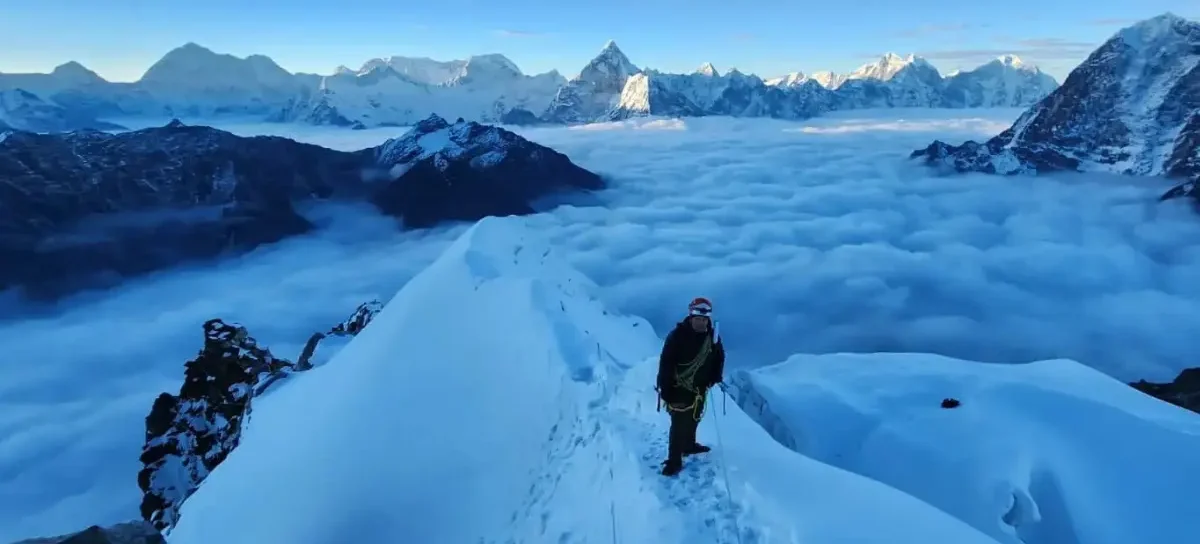
Anyone who has done some research on mountaineering in Nepal must have come across the name of Island Peak. This 6189 meter mountain, officially known as Imja Tse is located in the central part of the Everest region, surrounded by giant mountains such as Lhotse, Nuptse, and Ama Dablam. It is often touted as the “perfect first climb in the Himalayas,” and for a reason: it provides a taste of high-elevation mountaineering in a way that requires no years of technical climbing.
What Is Island Peak (Imja Tse): History Behind Its Name
Back in 1951, the British mountaineer Eric Shipton named the island peak “Island Peak”. From Dingboche, his team saw the mountain rising out of a sea of ice like an island surrounded by glaciers and the larger summits of Lhotse, Nuptse and Makalu surrounding it. Imja Tse is the Nepali name for the mountain, which is located in the Imja Valley.
The peak was first climbed in 1953 by the British Everest expedition team, during a training and acclimatization climb prior to the British’s assault of Everest that same year. Since then, Island Peak has been one of the most popular “trekking peaks” in Nepal, which are mountains that require no full expedition-style mountaineering, but do demand real mountaineering skills near the summit.
At 6,189 meters (20,305 feet), Island Peak is not like a walk in the park, but it’s also not in the same category as Everest, Ama Dablam, or other technical Himalayan giants. It sits in a sweet spot, high enough to feel like a genuine mountaineering achievement, but accessible enough that reasonably fit trekkers with some preparation can reach the top.
Where Is Island Peak Located?
Island Peak is located in the Sagarmatha (Everest) National Park, in the Imja Valley, southeast from the Base Camp of Everest. Accessed through the village of Chhukung which is a detour from the main path of Everest Base Camp. For this reason, almost all Island Peak treks involve climbing and trekking the classic route to Everest Base Camp, which means you are not only seeing the peak, but also Namche Bazaar, Tengboche Monastery, Everest Base Camp and Kala Patthar.
Quick Facts About Island Peak
| Detail | Information |
|---|---|
| Height | 6,189 m / 20,305 ft |
| Location | Imja Valley, Everest (Khumbu) Region, Nepal |
| Classification | Trekking peak (NMA-listed) |
| Difficulty | Moderate to challenging |
| Best seasons | Spring (March–May), Autumn (September–November) |
| Typical trip duration | 16–19 days (Kathmandu to Kathmandu) |
| Base Camp altitude | 5,100 m |
| Technical gear needed | Crampons, ice axe, harness, fixed ropes, ascender |
| Permit required | Island Peak Climbing Permit (NMA) |
Is Island Peak Good for Beginners?
Island Peak is widely considered one of the best introductory Himalayan climbs in the world, but “beginner-friendly” doesn not always means easy while climbing above 6000 feet.
To success the Island Peak climb, you don’t need to already know how to climb. Most people who summit Island Peak have never used an ice axe or crampons before arriving in Nepal. Your climbing guide will teach you the basic techniques, how to walk in crampons, how to use an ascender (jumar) on fixed ropes, how to self-arrest with an ice axe, and how to move safely on glacier terrain, during a training day, usually at Chhukung or at Island Peak Base Camp, before the summit attempt.
However, you do need to be fit and have high altitude trekking experience. Now, it’s not a difficult climb, but it’s at an extreme altitude, and even the most basic of movements is exhausting. This is usually 10 to 12 hours long, beginning hours before sunrise, and can be very cold. For hours at a time you will be hiking, climbing and using fixed ropes at an altitude of about 5,500 meters, where the air contains about half the oxygen present at sea level.
So the honest answer is: Island Peak is achievable for a fit, well-prepared beginner with no climbing background, but it is not a casual add-on to a trek. It rewards people who train beforehand and take acclimatization seriously.
Is Island Peak Suitable for Experienced Trekkers and Climbers Too?
If you have already done Everest Base Camp, Annapurna Circuit, or other high-altitude treks and you’re looking for the next step, Island Peak is a natural progression. It introduces you to actual mountaineering skills, roped travel, glacier crossing, and using technical gear, in a controlled, guided environment. Many climbers use Island Peak as a stepping stone toward bigger objectives like Ama Dablam, Mera Peak’s higher cousin, or even an eventual Everest attempt.
Experienced trekkers often find the physical trekking portion (the walk to Everest Base Camp and back through the Khumbu) relatively comfortable, since they’ve built up stamina from previous trips. That extra reserve of fitness and altitude tolerance can make a real difference on summit day, when fatigue and thin air combine to make even fit people feel slow and heavy-legged.
How Difficult Is the Climb, Really?
Let’s break down what actually makes Island Peak hard, because “difficulty” means different things to different people.
The trekking duration (Lukla to Everest Base Camp and on to Chhukung) is graded strenuous but not technical. You will be walking for five to eight hours a day on established trails, gaining altitude steadily, sometimes over rocky and uneven ground. If you have done any multi-day trekking before, you will recognize this part.


Top Trail Team during Island Peak Expedition.
The climbing portion is where things change. From Island Peak Base Camp (5,100 m), summit day usually starts around midnight or 1 a.m. The early hours are spent walking over rocky, loose terrain by headlamp. As you gain height, the route reaches the glacier, where you will rope up and put on crampons. The final headwall before the summit ridge is the steepest and most exposed section, this is where fixed ropes come into play, and where you will use an ascender to climb up the rope safely. Depending on conditions, this section can involve a nearly vertical ice wall of 30-40 meters. But the path to the summit ridge can be very narrow and steep sided and a calm head and a steady footing is as important as raw strength.
While none of this requires prior technical climbing experience, but it does require:
- Good cardiovascular fitness (you should be comfortable hiking 6–8 hours a day with a daypack)
- Mental resilience for long, cold, tiring days
- The ability to follow instructions precisely under fatigue
- No underlying health conditions that altitude could seriously aggravate
The Route: What the Journey Actually Looks Like
Day 1: Arrival in Kathmandu (1,350 m)
You will be picked up at Tribhuvan International Airport and driven to your hotel. There is a trip briefing in the evening that summarizes the trip, permits, equipment and what to expect in the next few weeks. Favorable opportunity to ask questions and get settled before the mountains.
Day 2: Trip Preparation Day in Kathmandu
A full day to complete final logistics: meet with the guide for a full inspection of your gear and permit paperwork, and last-minute shopping and/or rentals if needed for missing outfits. Enjoy free time in the afternoon to experience the city or for relaxation.
Day 3: Fly to Lukla, Trek to Phakding (2,610 m)
Once you arrive in Lukla, one of the most spectacular mountain airstrips in the world, you cross into Nepal.After your early flight you enter into Lukla, one of the most remarkable mountain airstrips in the world. It then starts a few hours along the Dudh Koshi river, to the small village of Phakding, with a few hours of gentle walking to get your gear, which is a first day meant to get you used to the pace of trekking.
Day 4: Phakding to Namche Bazaar (3,440 m)
The track continues along the river through pine woods and past mani walls and prayer wheels, over several suspension bridges, and into the Sagarmatha National Park at Monjo. From there a long continuous ascent takes you to the bustling Namche Bazaar, the hub of the Khumbu. When the weather is fine you’ll see a distant view of Everest on the ascent.
Day 5: Acclimatization Day in Namche Bazaar
Instead of a total stop, you will head up to Syangboche and Everest View Hotel (3,880 m) for a panoramic view of Everest, Lhotse, Ama Dablam and other peaks. Many groups then head on to the villages of Khumjung and Khunde and return to Namche afterwards for a second night.
Day 6: Namche Bazaar to Tengboche (3,860 m)
A picturesque path with almost continuous views of the mountains winds to Phunki Tenga and then to Tengboche via a rhododendron forest. The most well-known monastery in the region is located in this village: some of the most picturesque scenery on the entire route can be found here.
Day 7: Tengboche to Dingboche (4,410 m)
The trail sweeps through forest for a short time, crosses the Imja khola, and leads up to Pangboche before the forest is broken up and the scenery becomes more stark and high-alpine. Dingboche, surrounded by Ama Dablam and Lhotse, is the place to spend the night.
Day 8: Dingboche to Lobuche (4,940 m)
At the beginning of open valley, climb slowly up to Thukla and then a steep ascent to the summit of the Thukla Pass where memorial stones are erected in honour of those who have given their lives in the Everest area. Beyond this point, the trail turns rocky and glacial as it continues to Lobuche.


The Way to Island Peak
Day 9: Lobuche to Gorak Shep, Everest Base Camp, and back to Gorak Shep
This is a big day. The trail follows the edge of the Khumbu glacier to Gorak Shep and then crosses over the rocky glacial terrain to Everest Base Camp (5,364 m). There is ample opportunity to absorb the iconic landscape of the expedition before it’s time to head back to Gorak Shep for the evening.
Day 10: Kala Patthar (5,545 m) and on to Chhukung (4,730 m)
Before sunrise, you will climb to Kala Patthar for what’s widely considered the best up-close view of Everest on the entire trek. After breakfast back at Gorak Shep, the route heads back down through Lobuche and Dingboche, then branches east into the Imja Valley toward Chhukung , your staging point for the climb ahead.
Day 11: Acclimatization and Climbing Preparation at Chhukung
A well-earned rest day after the push to Base Camp and Kala Patthar, combined with practical climbing training. Your climbing guide will run through crampon technique, ice axe use, harness fitting, and how to move on a fixed rope, so you’re ready before heading higher.
Day 12: Chhukung to Island Peak Base Camp (5,100 m)
A short but tough day, passing by the rocky, glacial scenery with Island Peak now well in sight. Next, after settling into Base Camp, your team does any final checks on gear, briefs you on the summit plan, has a meal early, and gets some rest before setting out on the night climb.
Day 13: Island Peak Summit (6,189 m) and Return to Base Camp
Early mornings are the beginning of Summit day, typically starting around midnight, in order to take advantage of the more ideal weather and snow conditions. The trail leads up a rocky section before arriving at the glacier, where crampons and ropes will be necessary. The last headwall is the steepest wall, which is done using fixed ropes and ascender. In good conditions, you will make the ascent to the 6189m summit where you will enjoy a panorama towards Lhotse, Nuptse and Makalu and then safely return to Base Camp.
Day 14: Contingency Day
The day is give specifically because mountain weather can’t be controlled. If the summit was reached on Day 13, this day is used for rest and starting the descent. If poor conditions forced a delay, it becomes a second summit window.
Day 15: Chhukung to Namche Bazaar (3,440 m)
A long descending day retracing the route through Dingboche, Pangboche, and Tengboche, before dropping through forest and crossing the Dudh Koshi one more time on the way back to Namche. The lower you go, the easier the walking feels.
Day 16: Namche Bazaar to Lukla (2,840 m)
The final trekking day follows familiar ground back through Monjo, Jorsale, and Phakding before the last climb up to Lukla, a good evening to relax and share stories with your guide and crew before flying out.
Day 17: Fly Lukla to Kathmandu
A short mountain flight returns you to the capital. The rest of the day is free for a hot shower, some souvenir shopping, or simply resting after a demanding few weeks.
While this is the normal 17–18 day itinerary that we offer at Top Trail Nepal for groups, if you do not have 17 days or have more time available, we can help you customize an itinerary that suits you and helps you achieve your first 6,000-meter climb.
At Top Trail Nepal, we don’t just help you climb; we make sure you create wonderful memories along the way, with exciting mountain views and a friendly guide who is there to support and assist you throughout the journey.
Best Time to Climb Island Peak
One of the two best times is spring (March to May). Snow cover on the upper mountain is generally good, and the lower valleys are green with blooming rhododendrons, as temperatures gradually warm. This season also falls during the peak Everest climbing season, making the Khumbu trail a busy one with lots of Expedition Teams heading towards base camp.
The other classic season is Autumn (September – November). This is just after the monsoons, when the sky is generally clear and visibility is best of the year for the mountains. Nights are cold at high altitude, but the trails are dry and temperatures are pleasant for trekking.
Winter (December through February) is a possibility, but more challenging, colder weather, shorter daylight and more likely to be disrupted makes it a less popular time to climb or set out on flight, typically reserved for the most experienced climbers.
Monsoon (June to August) is generally avoided. Rain, cloud cover, leech-infested lower trails, and a higher chance of flight delays to Lukla make this the least suitable season for both trekking and climbing.
If your schedule allows it, aim for late September through early November, or April through May. These windows offer the best balance of weather stability, visibility, and safer climbing conditions on the summit ridge.
Permits and Paperwork Required for Island Peak Climbing
Since this trip combines a national park trek with an official peak climb, you will need a handful of permits before setting foot on the trail. All of these are arranged by your trekking agency ahead of time, so you don’t need to navigate the paperwork yourself , but it’s worth knowing what you’re paying for.
- Island Peak Climbing Permit Issued by the Nepal Mountaineering Association (NMA)
- Sagarmatha National Park Entry Permit
- Khumbu Pasang Lhamu Rural Municipality Permit
- TIMS Card (Trekkers’ Information Management System)
All these permits, including processing, are a part of our Everest Base Camp with Island Peak package, so at Top Trail Nepal, you don’t have to worry about any of these permits while you are busy training and preparing.
Island Peak is an unusual peak in many ways: it is a true Himalayan peak, with glacier travel and fixed ropes, but is accessible to ordinary fit people, not just the professionals. It will test your preparation, patience, and mental stamina to get to the top of a long, cold night. For the few who made the effort, the sight of Lhotse and Ama Dablam rising above the horizon makes for a memorable experience on that 6,189-m peak that will stay with them forever.
Need to start planning? Contact our team at Top Trail Nepal to answer your questions, to help you determine the best season and route, and to create a trip that suits your level and objectives.