
 Call Us or Whatsapp 9779808220612
 Email Us [email protected]
- English [EN]
- Espanol [ESP]
- France [FR]
- Deutsch [DE]
- China [CN]
- Japan [JP]
- Arabic [AR]
- Hindi [HI]
Mani Rimdu Festival Trek: The Masks, Mantras, and Mountains
Published: August 2026 | Author: Nishan Dahal | Category: Information
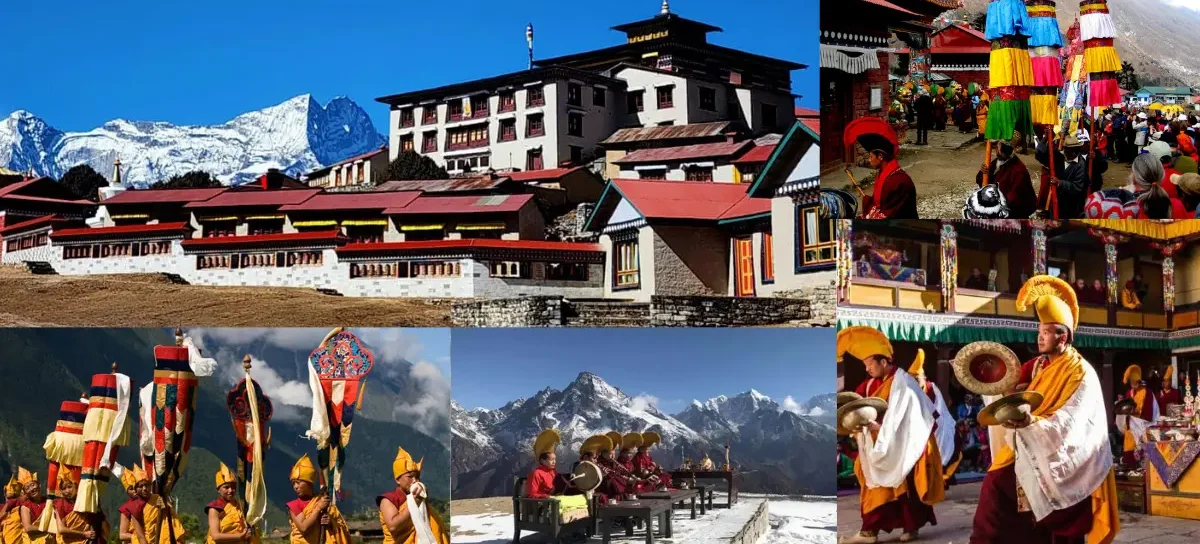
Mani Rimdu is an extremely old celebration that comes to life each autumn high in the Khumbu valley where the trail to Everest Base Camp passes prayer flags and mani walls. A monastery scene shows monks wearing colorful masks while spinning and jumping in the courtyard, and a mandala is created in a monastery courtyard, with smiling people gathering in the foreground, including hundreds of Sherpa villagers and tourists looking up to Ama Dablam and Everest. This is the Mani Rimdu Festival and the trek around it is one of the most rewarding experiences in Nepal; it’s two things in one trek – a real mountain trek and a live religious festival that few outsiders ever get to see up close.
What Exactly Is Mani Rimdu?
Mani Rimdu is a sacred Buddhist festival that is celebrated by the Sherpa community in the Everest (Khumbu) region of Nepal. It’s not merely a cultural event for visitors, but an authentic religious celebration based on Tibetan Buddhism, enacted by monks who have been training for it for weeks.
The meaning is inherent in the name. The mantra of the Buddha of Compassion, Chenrezig, is called “Mani,” and the famous one “Om Mani Padme Hum” is chanted numerous times in the rituals. The term “Rimdu” refers to the red pills which are blessed during the ceremonies and given to devotees as a spiritual drug known as Mani Rilwu. Together this Festival is a reflection of its main aim, compassion, blessing and protection for all living beings.
Mani Rimdu is about a story, the triumph of Buddhism over the older religion of the Himalayas, Bon. According to legend, Guru Rinpoche (Padmasambhava), the great Master who introduced Buddhism into Tibet, has subdued the spirits of the area and introduced Dharma here. This spiritual struggle between good and evil, ignorance and wisdom, chaos and order is enacted in the masked dances during the festival.
Where Is Mani Rimdu Celebrated?
Mani Rimdu is celebrated at three monasteries in the Solu-Khumbu district of northeastern Nepal:
Tengboche Monastery: the most famous and most visited celebration, sitting on a ridge at roughly 3,860–3,870 meters, directly on the main trail to Everest Base Camp, with dramatic views of Everest, Lhotse, and Ama Dablam.

Thame Monastery: a quieter, older monastery in a side valley near the Nangpa La pass, popular with those wanting a smaller crowd.
Chiwong Monastery: located near Junbesi in the lower Solu region, on a longer and less-trodden route.
Tengboche is directly on the standard Everest Base Camp trek and is by far the easiest and most popular spot to trek and visit the festival, which is what most “Mani Rimdu Festival Trek” packages are based around.
When Does It Happen? Mani Rimdu 2026 Dates
It is important to note that Mani Rimdu does not occur on a set date every year. It follows Tibetan lunar calendar and the actual dates will be notified by the head lama of the monastery (typically after Tibetan New Year). The public celebration is always on the full moon of the 9th or 10th Tibetan month, which is usually mid-October to mid-November.
The date also changes annually, which means that the trekking window may differ from person to person or company to company, and the dates may be altered nearer to the date of the event. The most recent schedule of events for 2026 has a main public festival days celebration at Tengboche Monastery around October 26, 27, and 28, 2026, which is the full moon of the 9th Tibetan month. Some operators have indicated slightly different dates, some closer to the early date in November and a smaller number the mid-November date — this is either because of different monastery schedules (Thame and Chiwong may have their own dates) or because of early listings before the final confirmation by the head lama.

What to expect: If you’re truly interested in visiting, plan to arrive sometime between late October and November 2026; the exact dates are contingent upon the lunar calendar and a local announcement, which cannot be set up in advance. The public festival is but the tip of a long process. The entire observance of Mani Rimdu is a 19 day ritual cycle. Monks privately carry out ceremonies in the monastery for the first 16 days or so – chants, makes a complex mandala sand sculpture in layers, and makes costumes and ritual items. The last three days are open to the public, but most trekkers schedule their trip around the final three days.
The Story Behind the Three Public Days
Every day of the public festival is unique and has its own celebration. Although there are very slight differences from monastery to monastery, the basic order is as follows:
Day 1: The Wong (Empowerment Ceremony). The festival opens with a formal blessing. There is a public empowerment, in which the head lama provides blessed offerings to all in attendance, such as the sacred Mani Rilwu pills. Today is a day of silence, prayer and spiritual preparation, not of performance. Many Sherpa people, monks and tourists line up patiently to receive the blessing from the Dalai Lama.
Day Two: Chham Dance(s) (Masked Dances). It’s the day that people associate with Mani Rimdu. Monks wear elaborate, brightly painted papier-mâché masks, representing a god, protector and demons, as well as heavy brocade robes. While beats of long horns, cymbal and drums, they engage in a series of ritual dances in the monastery courtyard. The dances are not haphazard, every gesture and character is a reflection of a specific figure in Buddhist cosmology and the sequence is a reflection of the victory of wisdom and compassion over ignorance and evil. It is colorful, hypnotic and symbolic, even if you don’t know each and every aspect of the choreography.

Day Three: Jinsakat (The Fire Puja and Closing). The last day is less intense. It contains also a fire ritual (Jinsakat) which is supposed to symbolically burn away the negative forces, which were “defeated” in the dances, and some comic/satirical dances that add humour to the fire ritual, which is otherwise very serious. The closing ceremony is the official end of the public celebration and at the end of the day, the sand mandala, which can take days to create, is ceremoniously destroyed, as a Buddhist reminder of impermanence.
The three days gives you the complete sweep of the story. It is usually said that the masked dance day (day 2) is the most interesting day, but having arrived on time for the opening blessing makes things more interesting for the rest of the day.
Why Trekkers Love This Festival?
The overwhelming majority of visitors to the Everest region visit just for the mountains: the heights, the passes and the excitement of getting to Base Camp. The Mani Rimdu Festival Trek is not just about the festival; it’s about immersing yourself in the life of the people who make this valley their own. You don’t simply pass by monasteries and prayer wheels, you sit in the courtyard of a monastery, with monks, elders, children and yak herders all watching the same dance, all in the same moment. For many trekkers, that shared experience, and not the summit photo, is the most memorable part of the trip. It’s also, in reality, a great method to pack two bucket-list experiences into one trip (without needing to repeat the journey to Nepal): the trek to the Himalayas and the somewhat unique cultural festival.
The Trek Route: How You Get There
The usual trek to see Mani Rimdu at Tengboche is nearly the same route as for the classic Everest Base Camp trek for the first few days or so. This is a typical example of an itinerary:
Day 1: Fly from Kathmandu to Lukla, trek to Phakding. The journey starts at one of the world’s best known short flights to the small mountain airstrip at Lukla (2860m). Then a gentle two or three hour walk along the Dudh Koshi (Milk River) leads to the village of Phakding.
Day 2: Phakding to Namche Bazaar. This is a longer more challenging day (approx. 6 hours walking) including a steep ascent to Namche Bazaar (3440m), official capital of the Khumbu, the largest Sherpa town in the area. There are several suspension bridges to cross over the roaring Dudh Koshi on the way and if the sky is clear then you can see the first sight of Everest from a point halfway up the climb.

Day 3th: Acclimatisation Day at Namche. Next to 3000 meters one has to be aware of the possibility of altitude sickness, so most itineraries include a rest day here. But “rest” is not a static exercise, it’s suggested that you hike up higher and sleep down lower, and so many groups venture to the Everest View Hotel or to the villages of Khumjung and Khunde. The Hillary School was built with the help of mountaineer Sir Edmund Hillary and in Khumjung is a monastery which is said to house a relic thought to be the scalp of a yeti. Khunde has a small hospital, also connected to Hillary’s Himalayan Trust. There’s also a fantastic opportunity to view the Sherpa Culture Museum in Namche as well as all of the bakeries, gear stores, and vibrant weekend market.
Day 4: Namche to Tengboche. It winds through the hillside, offering a continuous view of the mountains all the way down to crossing the Dudh Koshi once more, followed by a steady ascent through rhododendron and pine trees to a peak at Tengboche (3,860m). This is where the monastery (and the festival) awaits. In fact, the last stretch of track to Tengboche, up to the Ama Dablam that rises up directly in front of you, is one of the most beautiful in the whole Himalaya, according to many trekkers.
Day 5-7 Festival Days in Tengboche. This is the essence of the trip. You should expect to be based in or around Tengboche for two to three days depending on the exact dates that have been confirmed for 2026, and will attend the empowerment ceremony, masked dances and closing fire ritual; there will be time between activities for you to explore the monastery grounds, meet with monks and soak in the atmosphere.
Beyond Tengboche, there are two options. Once the festival concludes, trekkers generally choose one of two paths:
- Return route (shorter trip – approximately 9-11 days): Head back down through Namche and Phakding to Lukla and fly back to Kathmandu. It is ideal for those who travelled with the primary purpose of attending the festival.
- Continue to Everest Base Camp (longer trip, 14–18 days total): Keep on going through Dingboche, Lobuche and Gorak Shep to reach Everest Base Camp (5,364m) and the Kala Patthar viewpoint (around 5,545m) and come back on the same path. This is ideal for trekkers who are looking for the culture celebration along with the full experience of Everest.
There also is a shorter version of the trek, where operators avoid the return ascent to the higher altitudes and concentrate only on the ascent to the monastery, the festival, and the descent, ending up in well under 2 weeks (including flights) for those who do not have time.
How Hard Is the Trek?
The Mani Rimdu Festival Trek to Tengboche is considered a moderate trek, which means that it is more challenging than a simple stroll, but can be done by people of most fitness levels and with no serious heart or lung-related diseases. You should expect:
- Around 5–6 hours of walking per day on average, sometimes more on the Namche Bazaar day.
- Rocky, uneven trails with a lot of ascents and descents; the Himalayan trails rarely go in a straight, gentle line.
- Altitudes reach close to 3,900 meters at Tengboche, and considerably higher if you continue to Everest Base Camp.
- Cold temperatures, especially at night, once you’re above Namche.

The difficulty of the trek to Everest Base Camp increases significantly if you go for a longer period and take the extra altitude. While it is useful to have some experience in hiking, it is not a requirement, and there are many first-time hikers who do this route successfully every year, if they take the acclimatization days seriously and walk at a sensible pace.
Permits and Paperwork
To trek in the Khumbu region, including to Tengboche, you will need:
- Sagarmatha National Park entry permit, since Tengboche and the trail beyond lie inside Sagarmatha (Everest) National Park.
- Khumbu Pasang Lhamu Rural Municipality entry permit, a local area permit that replaced the old TIMS card requirement for this specific region.
- A valid Nepal tourist visa, arranged either on arrival at Kathmandu airport or in advance through a Nepali embassy.
There is no special “festival ticket” required to attend Mani Rimdu, the celebration itself is open to all and the standard trekking permits are only required to reach the monastery. One of the things that most trekking agencies don’t require you to do when you are booking a trek is to handle the permits, which is one less hassle.
Frequently Asked Questions
Not at all. While understanding the background adds meaning, the festival is visually stunning and emotionally moving even without deep religious context. A good local guide can explain the symbolism as it happens.
Yes, with good preparation. While there is no set age limit, any traveler with heart, lung or other serious health issues should get a doctor’s approval before embarking on this trip and older travelers/families with children should opt for the shorter Tengboche-only trip versus the longer one to Everest Base Camp.
Experienced hikers can do the trek independently as the path is well marked and teahouses are common. However, a licensed guide is useful beyond the logistical and safety aspects.