
 Call Us or Whatsapp 9779808220612
 Email Us [email protected]
- English [EN]
- Espanol [ESP]
- France [FR]
- Deutsch [DE]
- China [CN]
- Japan [JP]
- Arabic [AR]
- Hindi [HI]
Muktinath Temple History: The Full Story of Nepal’s Sacred Temple in the Sky
Published: July 2026 | Author: Nishan Dahal | Category: Information
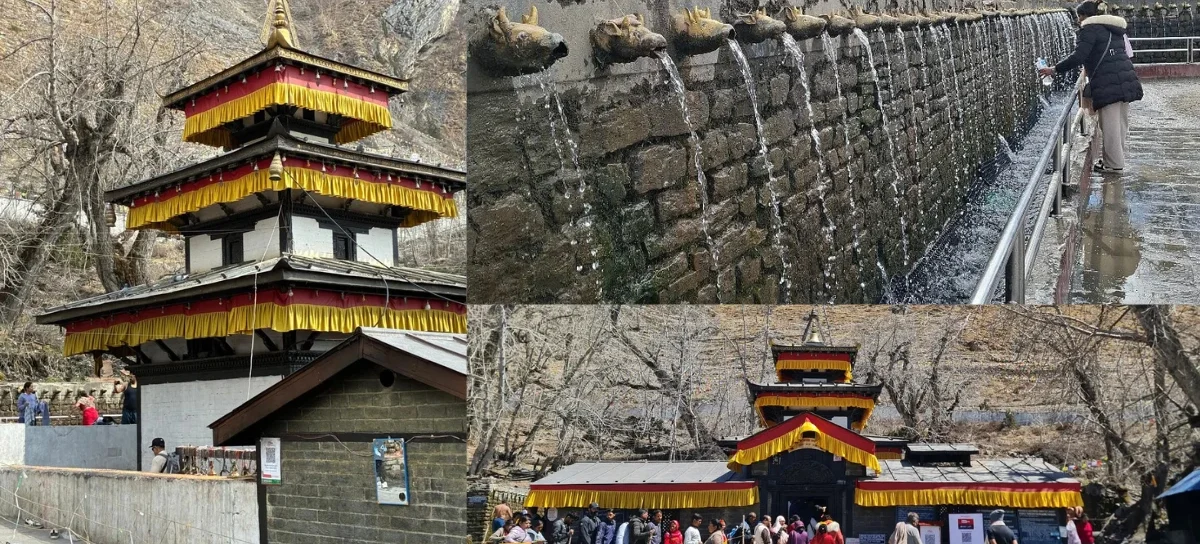
Muktinath is one of the holiest place on earth that sits at a height of about 3,760 meters, on th epic landscape of Mustang District. Muktinath is not just a temple. It is a meeting point of two of the world’s oldest religions, a spot where fire burns on water, and a place where the rocks under your feet were once the floor of an ancient ocean. Muktinath in not just about “moksha” and “108 water spouts.” It holds much more than a mythological belief, it alos tells the geology behind the legends, the old trade routes that made this place important.
The Significance of Muktinath in Connecting the Ancient Histories of Three Countries
Muktinath is located between the Dhaulagiri mountain range and the Annapurna mountain range in Mustang district of Nepal. It is located near a village known as Ranipauwa, not far from an ancient settlement called Kagbeni, where Kali Gandaki and Jhong rivers meet. The site is one of the highest in the world for a temple and the placement is not coincidental. It is located on a path that has been used for thousands of years to link Tibet with Indian plains. The Kali Gandaki valley is one of the few natural gaps in the entire line of the Himalayas. The peaks of the mountain range are more than 6,000 or 7,000 meters tall, but the Kali Gandaki valley has deepened between Annapurna and Dhaulagiri to a level low enough to be traversed by people, yaks and mules. This thin strait had been used by traders and pilgrims for centuries. Tibet’s salt flowed down. Northward: Grain, spices, and cotton from India. This was known as the Salt Trade Route and Muktinath lay nearly on it. The Kali Gandaki Trade Route, also known as the route of the Kali Gandaki, was a route that facilitated the movement of people, goods and ideas between India and Tibet, allowing religious and cultural influences to be shared freely.


For many generations, this trade was in the hands of a local group known as the Thakali. The Thakali people of the Thak Khola Valley used to be famous salt traders and Kali Gandaki river was a key trade route between Tibet and India, which traded salt, spices and cloth. Until the middle of the twentieth century, they were prosperous, until politics changed all that. However, political changes within Tibet around 1949 put an end to the Nepal-Tibet trade (along the Salt Route) and to the supremacy of the Thakali trading families in the upper Kali Gandaki region. So Muktinath was never a lonely place of worship, standing high atop a mountain. It was developed beside one of the busiest passages in the Himalayas and all the traders, monks and pilgrims who traversed the area contributed to its history.
Muktinath Land Itself Has a Story Older Than Any Religion
The landscape of the Mustang region and the hills around Muktinath used to be the bottom of a sea. This whole area was underwater millions of years ago before the Indian landmass crashed into Asia and pushed the Himalayas up.Before millions of years ago when the Indian landmass crashed into Asia and lifted the Himalayas, this entire area was underwater, part of an ancient ocean scientists call the Tethys Sea. That ancient sea bottom and all the contents of the sea, including the shells of sea creatures, were raised as the mountains were formed.


The famous black stones of this region are called Shaligram stones and are made here. The fossilized ammonites like these are a relative of the squid and octopus and occur in the riverbed of the Kali Gandaki only at Muktinath. Nobody has carved or shaped these stones, so they are considered as self-sculpted forms of the god Vishnu; this self-made, natural notion of an object that has not been touched by human hands is what gives these stones their significance in worship.
The Name Muktinath and What It Means
The word Muktinath comes from two Sanskrit words. Mukti means release or liberation and Nath means lord or protector. It is a combination of the words “Lord” and “Liberation. For Hindu’s it is the ground where the pious soul can get free from the cycle of birth and death, that is the endless round. For Hindu’s this is the ground where a devoted soul can be liberated from the endless round of birth and death, called ‘moksha’. In the same sense, but with a slightly different emphasis, the same place for Buddhists is associated with spiritual awakening and not with liberation from rebirth.
The site is also known as ‘Mukti Kshetra’ or ‘the field of liberation’ according to Hindu belief. In Hindu scriptures, Muktinath is called Muktik Setra or Mukti Kshetra, which translates to “place of liberation” or “place of moksha” and is considered one of the 105 sacred places in the Sri Vaishnava tradition known as the 108 Divya Desams. It was important to note that the old texts by Sri Vaishnava in the Sri Vaishnava scriptures used to call it another name altogether before it was known by its present name.

On the other hand, Buddhists employ another name which refers not to the spiritual results of the visit, but to the physical one. It is known as Chumig Gyatsa (Tibetan for “Hundred Waters”) by Buddhists due to the numerous spouts of water at the site. It is a minor but significant indication of how two traditions came to the same physical place from two very different directions and developed their own meaning for it, rather than one tradition borrowing from the other.
What the Old Verses Actually Say About Muktinath
On the Hindu side, Muktinath is mentioned in the Nalayira Divya Prabandham, which contains four thousand Tamil devotional verses written by twelve poet-saints called the Alvars, of about the 5th and 8th centuries CE. Of the 108 Divya Desams, or Vishnu temples revered in these verses, Muktinath is the sole temple outside India. There are 108 Divya Desam temples, each of which is part of the Srishti, 105 in India, 1 is in Nepal and the last two are thought to be altogether outside of the earthly realm. One aspect of this shrine that is hardly ever referenced elsewhere is that it was honored with hymns written by one of the twelve poet-saints called Alvars, who never visited it in person, Thirumangai Alvar. Thirumangai Alvar was unable to visit Muktinath, but from the nearest place he could, he wrote ten verses about Muktinath, and another poet-saint, Periyalvar, sang about Vishnu in Muktinath, under the name Salagramamudaiya Nambi. This is a sign that this far out shrine in the Himalayas had already gained enough renown that it was known to a poet who never set foot near the Himalayas, and touched by its splendor he wrote it into his poems.

Likewise, even older is the mention of this section of the Kali Gandaki that can be found in the Ramayana, which is different from the name of Muktinath but has the same connotation of crossing over to freedom. The site has been referred to in the Ramayana and other ancient Hindu scriptures as “Mukti Tirtha”, and Hindu pilgrimages may have begun before one of the ethnicities inhabiting the site were present. It’s a more robust and older argument than the oft-repeated one that the temple ‘dates back to the first century AD’ and is worth more attention than it usually receives.
The Temple Building We See Today
There is quite a difference in the temple we see today and what it was years earlier. Today, the visitors enter into a pagoda-style temple, which was constructed in the early nineteenth century by the Nepali kings. The present pagoda style temple was built around 1815 AD by Queen Subarna Prabha Devi, the wife of King Rana Bahadur Shah, daughter-in-law of King Prithvi Narayan Shah. Another source provides a variant of her name and provides a bit more detail regarding the purpose of the structure. The building of this structure for Vishnu and to Chenrezig in 1815 by Queen Subarna Prabha was an important event in the history of the temple. On the interior, the central figure is a human-sized, clothed copper statue of Vishnu, sitting in the padmasana (lotus position).

In the temple interior, there is a human sized copper figure of Shri Vishnu sitting in padmasana in yellow, with Saraswati, in red and Lakshmi in red. The ground itself is sacred, and revered by many for its stories that date back many centuries, by scripture and old trade routes, but the building that most people take pictures of is only about two hundred years old. Both of these are true and a good understanding of Muktinath should take two, rather than reduce to one platonize-able “ancient temple” story.
Fire That Never Goes Out: The Jwala Mai Shrine
There is another, smaller temple, just behind the main Vishnu temple, which is even more impressive than the main temple. This is the temple of Jwala Mai, which contains a flame which has been burning for a long time without being lit by anyone or fed by any individual with fuel. The flame of Jwala Mai Temple is one of the rarest natural phenomena on earth; a flame which burns simultaneously over water, earth and rock in a small shrine nestled on the hillside behind the main temple.
Although the scene is almost magical when experienced first-hand, the scientific explanation is simple. The methane and other natural gases that fuel the flame are leaking through fissures in an old sedimentary rock under the Muktinath area, an area uniquely located in one of the most geologically active regions on Earth. It’s quite a description from a local guide: The shrine is constructed above an underground water stream, and small natural gas jets under the structure create flames that burn continuously just directly over the water. In fact, the Tibetan tradition of Buddhism has three different names for these flames, depending on where they occur in the world. In Buddhism, they are called burning soil, burning stone and burning water, respectively.
That’s the reason why they’re saying the site is so complete spiritually. Fire which burns on water, next to solid rock, high up where the wind never rests brings together four of the five classical elements in one small space. It seems that, along with earth, water, fire and air, the holiness of the flame is a key element in Muktinath’s religious significance as it is one of the few places where all four are present at the same time. Hindu faith further adds this as the fire is seen as a creation of God. According to Hindu belief, this fire was lit as an offering by the creator god Brahma, who is believed to have lit water itself on fire.
The 108 Water Spouts and What They Represent
The other distinguishing feature of Muktinath is the ring of 108 stone spouts around the temple courtyard, each converging a fine stream of cold water, that flow constantly. Under each and every spout, pilgrims walk and the water falls upon their shoulders and back, in the hope that it will wash away accumulated sin. This feature gives its name to the Tibetan name of the temple, Chumig Gyatsa, meaning “Hundred Waters.

The number 108 is no coincidence. It has a significant significance in Hindu and Buddhist philosophy, representing the concept of cosmic completeness and also the number of earthly desires or defilements a person must conquer in order to attain nirvana. The 108 spouts represent the 108 defilements of the mind, and the pilgrims feel that allowing the water to run over their bodies purifies them and gives them a kind of liberation, as it is believed to wash away the 108 defilements from their minds. The water is also given religious significance that is connected to the river below. This water is said to be from the Kali Gandaki River, which is said to be an embodiment of Vishnu. In practical terms it’s simply glacial meltwater funnelled down from the peaks above but the ritualistic meaning placed upon the simple fact is what makes a walk under some stone taps a real pilgrimage for millions of people.
Muktinath in the Modern Era
Muktinath could only be reached by a long and difficult journey over the mountains, and naturally only a few were able to make the journey for much of its history. This changed in the 20th century when the trails were developed and in the more recent years, roads and short flights were built to bring Pokhara and Jomsom into the main pilgrimage circuit. Today, too, faithful pilgrims, trekkers, and inquisitive travelers visit the same spouts and the same flame, for different reasons.
There’s a broader history to the Mustang region encompassing Muktinath. Initially Mustang was an independent kingdom known as Lo and its monarchial dynasty lasted for centuries after the change of the Nepal. Mustang was once a kingdom but in 2008 its monarchy was eliminated and its last king, Jigme Dorje Palbar Bista, passed away in 2016, spending his retirement years in Kathmandu. Physical evidence of even older human presence in this valley is also found nearby. On the far side of the river Kali Gandaki and high on the dramatic cliff face are groups of caves that are ancient and of unknown origin but thought to be used between the ninth and seventeenth centuries.