
 Call Us or Whatsapp 9779808220612
 Email Us [email protected]
- English [EN]
- Espanol [ESP]
- France [FR]
- Deutsch [DE]
- China [CN]
- Japan [JP]
- Arabic [AR]
- Hindi [HI]
Top 5 Places to Visit on the Sirubari Village Tour: Home to Nepal’s First Homestay Experience
Published: August 2026 | Author: Nishan Dahal | Category: Information
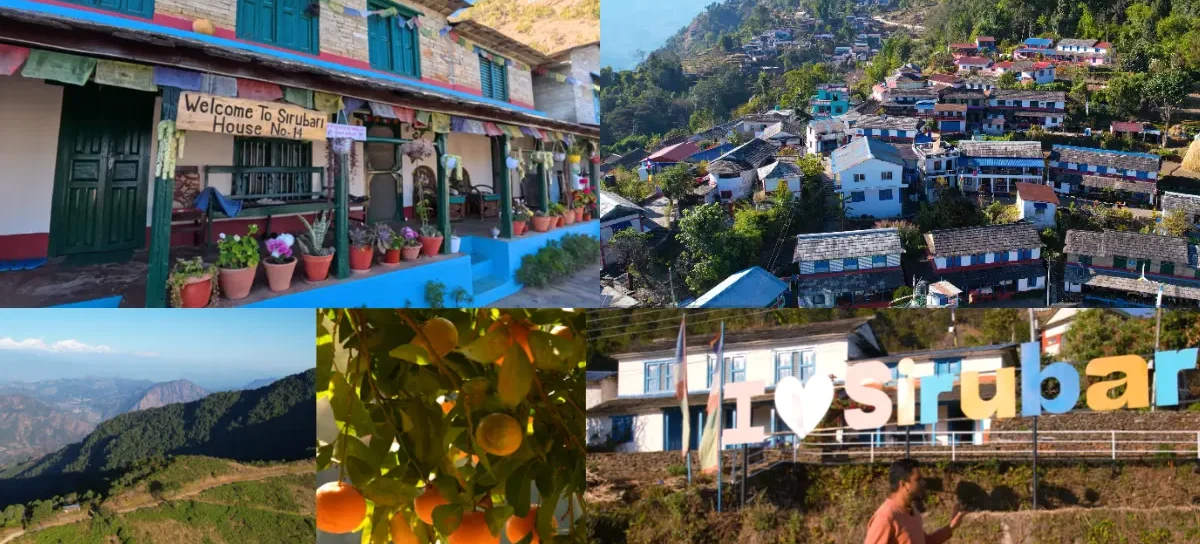
Located in the hills of Syangja district, a few hours drive southwest of Pokhara is a small stone-paved village that quietly changed Nepal’s perception of tourism. Sirubari is not known for a mountain peak, a lake or a temple. It is well-known for an open door. This Gurung settlement has been open to visitors since 1997 and welcomes them to its normal households, normal tables, and to live an ordinary village life for a night or two. The concept won Sirubari the first homestay village title of Nepal and in 2001, it won the PATA Gold Award, in the category of Heritage and Culture, proving it was exactly what it was meant to be.
The primary reason that most people go to Sirubari is to stay at the homestay. Once you’re there, the village has much more to offer: a sunrise hike, some of the finest trails in the mid-hills, a small monastery with its own gentle routines, and a series of community projects, which reveal the possibilities of a self-reliant hill village. If you are making your plans to visit a village of Sirubari, Thumro Juro viewpoint, the Gurung homestay experience, the village gompa (monastery), the nature trails through forest and terraced farmland, and Sirubari’s community development projects are the top 5 Sirubari Village Tour places that you cannot miss.
Thumro Juro – The Sunrise Viewpoint
As far as sleeping in Sirubari is concerned, you will not want to miss the sunrise from Thumro Juro. It is the highest point on the ridge south of Pokhara and locals will tell you that this offers one of the widest panoramic views of the mountains, without requiring much real effort or trekking gear.
The hosts of most homestays will wake people up early in the morning, greet you with a cup of hot milk tea and guide you up a steep but short path that leads out of the village and onto the open grassland. The walk is less than an hour, but the reward is greater than the effort. The sky becomes lighter, and a large expanse of the Annapurna Himalayas comes into view, Annapurna, Dhaulagiri, Machhapuchhre (the obvious fishtail peak), Manaslu, Lamjung Himal, Nilgiri and Hiunchuli all make a line across the horizon in one broad sweep. With its altitude of approximately 1,700m, the air is not so dense as to make the view blurry, but not so dense as to make the climb too strenuous.


It’s the longest sitting spot for photographers. The light on the snow shifts every minute in the 20 or so minutes following sunrise; from light pink to gold to a hard bright white. Even travelers who are not particularly interested in mountaineering or photography usually admit that this half-hour on the ridge becomes the memory they talk about most once they get home.
The Gurung Homestay Experience
The homestay is not just a place to stay in Sirubari; it is the essence of the village’s existence and should not just be a place to rest between sightseeing, but a place to visit as a tourist. The entire homestay system is managed by the Tourism Development and Management Committee of Sirubari, which consists of families from Sirubari. There is no choice of host family, and no choice of guests; visitors are selected one after another by the committee, and the experience of being a host is fairly distributed among the roughly seventeen participating families in the village, as is the income.
The entire operation is kept small with approximately sixty beds scattered among these homes, rather than resort-style. On arrival, flowers are usually presented at the village entrance and pancha baja (Nepal’s traditional five instruments) plays a musical welcome at the village entrance. Guests are then taken to the monastery in the village before heading home where the real experience starts. You sleep in an extra room in a working family’s home, eat food which is prepared on the family’s stove, and are invited into their activities for the day; feeding the animals, husking corn, tending the vegetable patch, sitting by the fire, or just chatting.

Sometimes there is communication that relies on gestures and English words that are limited to a few, and somehow, that makes communication more real, not less. Food is a special treat all by itself. Simple Nepali vegetarian and grain-based dishes prepared using the vegetables and grains that grow in the garden, dal bhat, seasonal vegetables, buffalo leafy vegetables (gundruk), and sometimes hot buffalo milk at night. The village has a folk programme in the evening which includes Gurung songs and Ghantu or Sorathi dancing, and the community sings, with the guests being heartily but somewhat coarsely invited to join.
The Village Gompa and Its Quiet Spirituality
Before any guests are sent off to the host homes, most Sirubari tour itineraries start with a visit to the small Sirubari monastery known as the gompa. It is not a large building; there are no large monasteries here to rival the carved temples of the Kathmandu Valley or Mustang, but its simplicity is part of its appeal. The courtyard is adorned with strings of prayer flags, which flutter in the wind, and the interior walls are decorated with hand-painted Buddhist symbols, many of which are also influenced by the older religious traditions of the Bon people.

Visitors are sometimes welcomed on short visits for a small blessing from the resident lama, which sets the tone for the remainder of their stay. It’s been a stop that many travelers say marked the transition from ‘sightseeing’ to a more contemplative part of their journey, and for good reason: Sirubari’s culture is more than just the picturesque terraced fields and mountains. It only takes 15 minutes to visit here, but it provides a background to the rest of the day. A brief knowledge of Gurung spiritual life helps to better appreciate the evening dances, domestic rituals, and even the layout of the village. When we were on our way to the Siriburi Homestay experience, our guide took us to the Gomba. We were a little curious about why the Gomba had come along our way, but when we reached there, we came to understand its essence, its peaceful appearance, and the culture it reflects, which can be seen in the people of Siriburi.
Nature Trails Through Forest, Terraces, and Farmland
There is a lot of flora and fauna in the village and a large part of the idea of experiencing Sirubari without haste is the network of easy walking trails which form a loop within the village and wind through the surrounding forest and farmland. The trails leading from Sirubari to neighbouring hamlets such as Thapala and the larger Arjunchaupari area pass by oak and rhododendron forest (if you plan your trip for spring when these trees are in bloom, it will be spectacular), terraced fields cut into the hillside, and small streams.
The forest cover is conducive to the presence of a good amount of Himalayan foothill species, making this part of the trip appealing to birdwatchers. No special equipment or fitness is required for these walks, these walks are designed to be gentle enough for most ages and can be either a half-day outing or a quiet walk of one hour before dinner.

You will cross normal scenes from hill life which seldom appear in brochures: buffalo grazing on a narrow terrace, corn drying on a roof, someone walking up a steep hill carrying a doko (bamboo basket) of fodder. It is these seemingly insignificant moments that visitors can often remember as strongly as the big mountain scenery from Thumro Juro. When traveling with a guide from the village, have them identify the common names of plants and trees; Gurung people have a wealth of local terms for hill plants and trees that are not often used in guidebooks.
Sirubari’s Community and Sustainable Development Projects
The fifth destination on this list is not as “scenic” as the others, but is perhaps most essential to the understanding of why Sirubari is a tourism model in the first place. A few small community institutions were constructed and maintained using income from tourism, scattered throughout the village , a primary health center, an agricultural service center, a small veterinary facility, a plant nursery and areas of community forest plantation.
None of these are tour attractions in the usual sense of the term (no ticket booths or gift shops), but a walk by and listening to the way they are financed gives the visit some real texture. Tourism was never envisioned at Sirubari as a source to acquire tourist cash from, rather, the late Rudra Man Gurung envisioned turning tourism into something that would boost community health, agriculture, and the environment. The health centre also allows villagers to not have to spend hours on their journey to get basic health care. Agricultural activities and services accommodate the same farmers who provide dinner for visitors later in the day at the veterinary services.

The nursery and forest plantation safeguards the very hillsides that make the sunrise at the Thumro Juro so beautiful. It’s seeing this side of Sirubari that makes the entire journey feel like a different experience. While it can be easy to see a homestay as cozy and photogenic, it is important to understand the cooperative management, rotating host responsibilities, and reinvestment in local services that have made the Sirubari homestay a true and well managed village for over 40 years since it opened.
Planning Your Visit
Sirubari is located in the district of Syangja about 55-65 km southwest of Pokhara. The path is usually a drive from Pokhara along the Siddhartha Highway towards Karkineta, and then a walk to get into the village, as the last section is not road-worthy. Most people make their way from Kathmandu to Pokhara (approx. 200 km, 6–7 hrs by road or a short flight) and then proceed to Sirubari by road. They also like taking the walk-in as well from a nearby drop-off point like Naudhada or Arjunchaupari as it is a gentle way to get into the slower tempo of the village.
The skies are the clearest and visibility of the mountains is the best from Thumro Juro in the autumn (September to November) and spring (March to May) when the daytime temperature is comfortable. There are also rhododendrons in the surrounding forest that flower in the spring. Winter (December-February) is cold but quite usable, with fewer visitors and the possibility (hope) of crisp, clear mornings, which are the best times to shoot sunrises, if you can get up early enough in the cold winter months. Peak times for the monsoon are the months from June to August when the mountain views can be obscured behind the clouds, but the green terraces are abundant.
Sirubari is not a place you visit for a single headline attraction. Its appeal is much more than that: a sunrise that stops you in your tracks, a family dinner that runs long because nobody wants it to end, a monastery blessing that lingers longer than expected, a forest walk that reveals the rhythm of hill farming, and a set of community projects that quietly explain why all of it still works, decades after it began. Together, these five experiences give a fuller, more honest picture of rural Nepal than almost any other single-village destination in the country. If you are looking for a trip that trades five-star comfort for something warmer and more real, Sirubari is worth exploring.